

Softball guide
Softball vs baseball: the key differences
Softball and baseball look alike, but they are not the same game. This guide explains the main differences in plain English, and clears up some common mix-ups.
What softball and baseball share
If your family already knows baseball, you are most of the way there. Both games use innings, three outs per half inning, balls and strikes, four bases and a diamond-shaped infield. A run scores when a player touches first, second, third and home in order. Gloves, bats and base running will all look familiar. The differences are real, though, and they change how the game feels. For a full walk-through of softball itself, see softball rules for beginners.
The pitch is thrown underhand
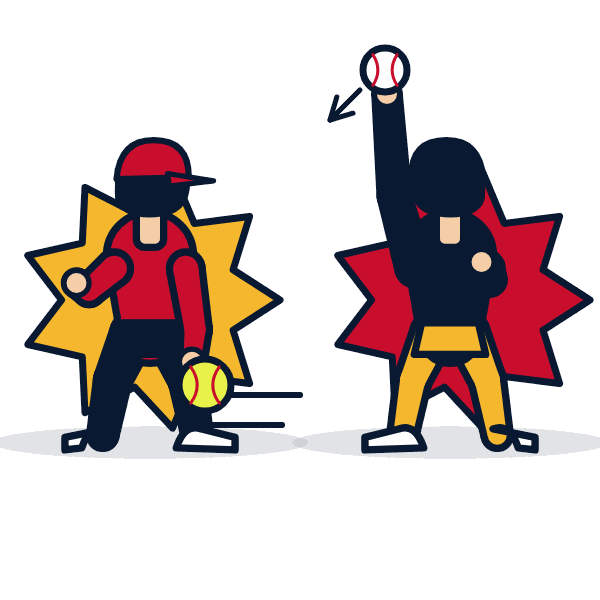
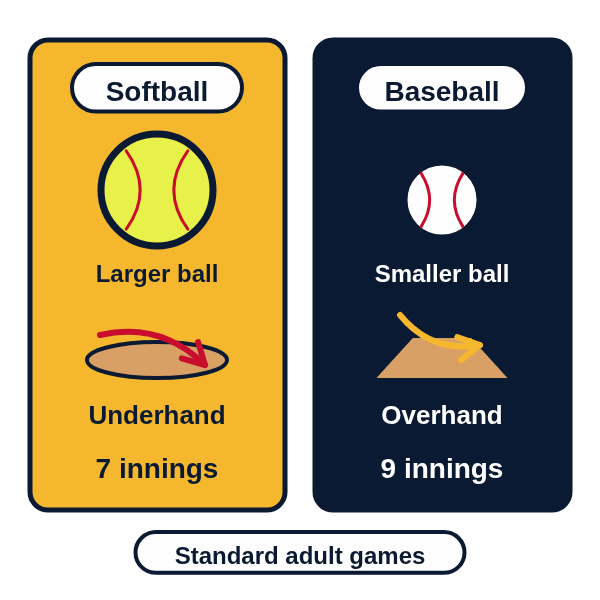
The biggest visible difference is the delivery. In fastpitch softball, the pitcher throws underhand, usually with a windmill motion, and releases the ball around hip level (the exact rule varies by rule set). In baseball the pitcher usually throws overhand from a raised mound. In slowpitch softball, the pitch is an underhand lob in a high arc. Softball pitchers throw from a flat circle rather than a mound. Pitching distance and the rules for the motion differ between the two sports and by age group, so check your league's rulebook for specifics.
The ball and the field
- The ball: a softball is larger than a baseball, and it is not soft. It is a hard ball, which is why helmets and catcher's gear matter. Many softballs are bright yellow so they are easier to see, though color varies.
- The field: softball fields are generally smaller than baseball fields, with shorter distances between bases and a shorter pitching distance. Exact dimensions vary by age group and league, so we will not quote numbers here.
- The bat: bats are designed differently for each sport and are usually not interchangeable. Leagues often require specific approved bats, so ask before you buy. The youth softball equipment checklist covers this in more detail.
- The glove: gloves look similar, but softball gloves are often made to suit the larger ball.
Running the bases
In fastpitch softball, runners may steal, but they cannot leave the base until the pitcher releases the ball. In standard baseball rules, runners are allowed to take a lead off the base while the pitcher is getting ready, although many youth baseball leagues restrict leading off. That difference changes the rhythm of the game. In softball, speed from a standing start matters, and a quick, accurate throw from the catcher is a big part of the defense. Many youth divisions in both sports limit or change stealing, so ask your coach what applies.
Game length
In standard adult rules, a baseball game is nine innings and a fastpitch softball game is seven. Youth games in both sports vary widely, and many leagues use time limits or run limits. Check your league rather than assuming.
Quick comparison
| Topic | Softball (fastpitch) | Baseball |
|---|---|---|
| Pitching style | Underhand, from a flat circle | Overhand, usually from a mound |
| Ball size | Larger | Smaller |
| Base distances | Generally shorter | Generally longer |
| Leading off | Not until the pitcher releases the ball | Runners may take a lead in standard rules |
| Standard adult game | Seven innings | Nine innings |
Common mix-ups
- Softball is just baseball for girls.
- It is its own sport with its own rules, equipment and strategy. It is also played by boys and men, especially in slowpitch leagues.
- A softball is soft.
- It is a firm, hard ball. Protective gear is important.
- Slowpitch and fastpitch are the same game.
- They share the basics, but pitching, bunting, stealing and the number of fielders often differ. Our positions guide touches on one of those differences.
- Skills do not carry over.
- Catching, throwing, fielding and baserunning habits transfer well in both directions, although hitting a larger, differently pitched ball takes some adjustment.
If your child plays both
Many children enjoy both sports. Expect an adjustment period when switching: a different bat, a different pitch speed and angle, and different base-running rules. Be patient, and tell the coach about the other sport so they can help. If your child is throwing a lot in both sports at once, ask a coach or doctor about rest, since young arms need breaks.
Want the lingo? Look up unfamiliar words in softball terms for new parents, or browse the softball guides hub.
Hitting a softball vs a baseball
Hitters notice the difference right away. A fastpitch softball comes in from a shorter distance and from below, so it often rises or drops in a way a baseball does not. The ball itself is bigger, which some players find easier to see and others find harder to time. Batters in fastpitch often have less time to react than they expect, while slowpitch batters have the opposite problem of waiting for a slow, high pitch to arrive. Swing mechanics are similar in the basics, but players who switch usually need a few weeks to find their timing. That is normal, so coaches and parents should expect some extra strikeouts at first.
Fielding and throwing differences
- The bigger ball is easier for small hands to see but can be harder to grip. Many softball players learn a throwing grip that suits the larger ball.
- With shorter distances, plays in the infield happen quickly. Softball infielders often need fast reactions rather than the longest throwing arm.
- Outfielders cover similar ground, but the ball may come off the bat differently, so reading fly balls takes practice.
- Catchers in fastpitch see a harder, faster pitch and often have to block balls in the dirt, so catcher's gear and good coaching are especially important.
Different leagues, different paths
Another difference is how the sports are organized. Youth baseball and youth softball usually run through separate leagues, with their own divisions, rules and calendars. Slowpitch is common in recreational and adult leagues, while fastpitch is the version most youth players move toward as they get older. In some towns, younger girls and boys play together in coach-pitch or tee-ball divisions before splitting into baseball and softball. Ask your local league how it handles this. If your child is deciding between the two, the best test is usually a season of whichever sounds more fun. Our fastpitch vs slowpitch explainer helps you sort out the softball side of that choice.
Questions to ask if you are switching sports
- Which equipment from the other sport can my child keep using, and which has to change?
- Does the league allow a bat or glove that was made for the other sport?
- How are pitching and stealing handled in this division?
- Does the league offer a clinic for players who are new to softball?
For help with a glove that fits the larger ball, see how to choose a softball glove. If you want to see the pitching side of the difference, how to start pitching in fastpitch softball explains the windmill motion step by step.
In BlackForge Sports: one app for every sport your family plays, with live scores, highlights that make themselves and parent-controlled profiles. Get early access and tell us you’re here for softball. Get early access →
Sources and further reading
- Softball (summary) Encyclopaedia Britannica
- About Little League Softball Little League International
- 2023 Slow Pitch vs. Fast Pitch Rule Differences USA Softball
Links open in a new tab. Quotations are short excerpts, included with attribution for commentary. BlackForge Sports is not affiliated with or endorsed by the people or organizations named.
Frequently asked questions
Is a softball actually soft?
No. A softball is a firm, hard ball, which is why helmets and catcher's gear matter.
Can I use a baseball glove or bat for softball?
Gloves may work for casual play, but bats are designed for each sport and leagues often require approved bats. Ask your league before buying.
Can runners lead off in softball?
In fastpitch, runners cannot leave the base until the pitcher releases the ball. In standard baseball rules, runners may take a lead off the base, though many youth baseball leagues restrict it.
Do baseball skills help in softball?
Yes. Throwing, catching, fielding and base running carry over, though hitting a larger ball pitched underhand takes some adjustment.
Is it hard to switch from baseball to softball?
Most skills carry over, but players need time to adjust to a bigger ball, an underhand pitch and different base-running rules. A season of practice usually helps a lot.