

Softball guide
Softball positions, explained
Softball has nine defensive positions in standard fastpitch, and each one has a job on every pitch. This guide explains who does what, and how beginners usually find their spot.
The big picture
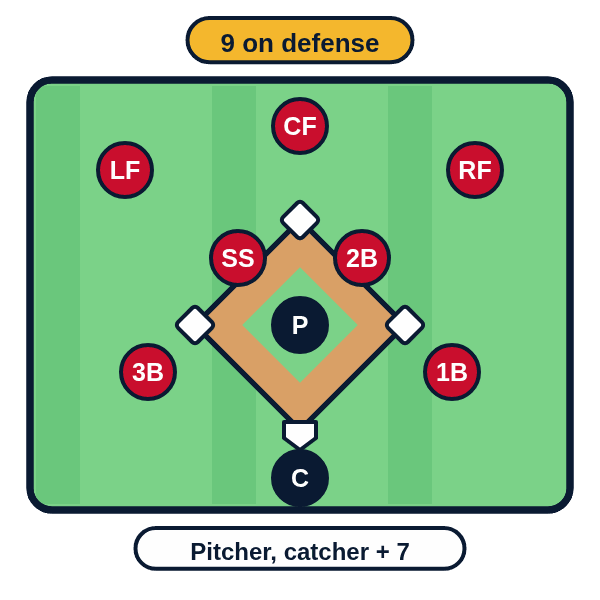
In fastpitch softball the defense puts nine players on the field in standard rules: a pitcher, a catcher, four infielders and three outfielders. Slowpitch often uses a tenth fielder, commonly an extra outfielder or rover, but that varies by league. Each position has a job on every pitch, even when the ball is nowhere near you. For the full rules of the game, see softball rules for beginners.
The battery: pitcher and catcher
Pitcher
The pitcher throws underhand from the pitcher's circle, and starts every play. In fastpitch, the pitcher also fields bunts and comebackers, and covers bases and home plate when needed. Pitching is physically demanding and technical, so young pitchers are usually brought along slowly with good coaching.
Catcher
The catcher crouches behind home plate, receives pitches, blocks balls in the dirt and throws to bases on steals. The catcher faces the whole field and often helps call pitches and direct teammates. Full protective gear is essential at this position.
The infield
- First base
- Catches throws to record outs at first and holds runners on. This player stretches for throws, so reach and footwork matter.
- Second base
- Covers the area between first and second. Often turns double plays and backs up throws.
- Shortstop
- Plays between second and third, usually with the most ground to cover. Needs quick reactions and a strong, accurate arm.
- Third base
- Guards the line on the left side of the infield. Fields hard-hit balls and bunts, and makes the long throw across to first.
The outfield
- Left field: covers the left side of the outfield and backs up third base.
- Center field: covers the most ground and usually takes charge on balls hit between outfielders.
- Right field: covers the right side and backs up first base on throws.
Outfielders are the last line of defense. They need to read the ball off the bat, call for fly balls loudly and throw to the right base.
Special roles you may hear about
- Designated player (DP): a player who bats but does not play defense. Many rule sets allow one, though the exact rules vary.
- Flex: a related role paired with the designated player in some rule sets, where a player may play defense while the DP bats. Ask your league how it works.
- Utility player: a player comfortable at several positions.
- Courtesy runner: a substitute runner allowed in some leagues, often for the pitcher or catcher.
Choosing a position as a beginner
Most young players try several spots. That is a good thing. Playing different positions helps a child learn the whole game and discover what they enjoy. Coaches often look at throwing arm, comfort fielding ground balls, willingness to talk and focus, but interests matter too. Some children love the action of the infield, while others prefer reading fly balls in the outfield.
Teamwork across positions
Softball positions are not islands. The shortstop and second baseman talk about who covers second on a steal. The outfielders call for fly balls so two players do not collide. The catcher and pitcher agree on what to throw. Young players learn a lot just by watching and listening to these small conversations, so encourage your child to speak up, point out where the runners are, and cheer for teammates. A loud, friendly team is usually a team that is paying attention.
What every player does on every pitch
- Know the number of outs and where the runners are.
- Decide before the pitch where you would throw the ball if it came to you.
- Get into a ready position with knees bent and glove out front.
- Move to cover or back up a base once the ball is in play.
Some terms here may be new. Look them up in softball terms for new parents, and see what a beginner needs to wear in the youth softball equipment checklist.
Who does what on common plays
Positions make more sense when you see them move. Here are a few plays you will see at almost every game, with the usual responsibilities in a simple setup. Coaches may assign things differently, so treat these as examples rather than rules.
| Play | Who fields it | Who helps |
|---|---|---|
| Ground ball to the shortstop | Shortstop throws to first | First baseman stretches for the throw, second baseman and third baseman cover or back up |
| Bunt in front of the plate | Pitcher, catcher or a corner infielder | First baseman covers first, shortstop or second baseman covers a base |
| Fly ball in the outfield gap | The outfielder who calls it first, with center field usually in charge | Other outfielders back up the play |
| Runner steals second | Catcher throws | Shortstop or second baseman covers the base |
| Passed ball with a runner on third | Catcher retrieves it | Pitcher covers home plate |
You will notice that nearly every play involves a base being covered and another player backing up. Young teams spend a lot of practice time learning these assignments, so be patient if they look unsure at first.
Skills each position tends to need
- Pitcher: patience, repetition and a willingness to work with a coach on mechanics. Strong fielding of bunts and comebackers is part of the job.
- Catcher: toughness, focus and a loud voice. Catchers see the whole field and are often the team's leaders.
- First base: good hands, comfort stretching toward a throw and willingness to be a big target.
- Middle infield (second and shortstop): quick feet, quick decisions and accurate throws.
- Third base: fast reactions and the courage to field hard-hit balls and bunts.
- Outfield: good judgment on fly balls, speed and a throw that carries to the right base.
These are tendencies, not requirements. Plenty of players grow into a position they did not expect to like.
Common mistakes new players make
- Standing still. Players who wait for the ball to arrive are slower to react than players who stay on their toes.
- Forgetting to back up. When a throw gets past a teammate, the player behind it prevents extra bases.
- Not calling the ball. Two players chasing the same fly ball without talking is the classic cause of collisions.
- Losing track of outs. A player who does not know how many outs there are cannot decide where to throw.
- Looking only at the ball. The best fielders glance at runners and the situation first.
What to ask your coach
- Will players rotate through different positions this season?
- What does the team expect of players who are on the bench for an inning?
- Is protective gear provided for catchers, and who handles that?
- How does the team handle pitchers, and when can a new player try pitching?
If your child is curious about the circle, our guide on how to start pitching in fastpitch softball covers the basics, and how to keep score in softball shows how each position gets a number in the scorebook.
In BlackForge Sports: one app for every sport your family plays, with live scores, highlights that make themselves and parent-controlled profiles. Get early access and tell us you’re here for softball. Get early access →
Sources and further reading
- What's the Score?: The Basics of Scorekeeping Little League International
- About Little League Softball Little League International
- Softball (summary) Encyclopaedia Britannica
Links open in a new tab. Quotations are short excerpts, included with attribution for commentary. BlackForge Sports is not affiliated with or endorsed by the people or organizations named.
Frequently asked questions
How many players are on the field in softball?
In standard fastpitch rules the defense has nine players. Slowpitch often uses ten, but the number varies by league.
What is a designated player in softball?
A designated player, or DP, is a player who bats but does not play defense. Rules vary by league, so ask yours.
What position should a beginner play?
Most beginners try several positions. Coaches look at throwing, fielding comfort and attention, and your child's interests matter too.
Which position is the hardest?
Pitcher and catcher take the most specialized skill and gear. Every position matters, and every player has a role on each pitch.
Do all softball players have to learn every position?
No, but most youth coaches rotate players through several spots so they can learn the whole game. Specialized roles such as pitcher and catcher usually come with extra coaching and protective gear.