

Softball guide
Softball terms for new parents
Softball has its own language, and it can sound confusing at first. This glossary explains the terms parents hear most, in plain English.
How to use this glossary
Softball has its own language, and it can sound like a secret code at your first game. These are the terms parents hear most often, in plain English. Some details differ by league, so ask your coach if something here does not match what you hear. For the full rules, see softball rules for beginners.
The game
- Inning
- One turn for each team to bat and play defense. A team's turn ends after three outs.
- Out
- When a batter or runner is removed from play, for example by a strikeout, catch or tag.
- Run
- A point, scored when a player touches all four bases in order.
- Fastpitch
- The version of softball where pitchers throw hard and fast, underhand.
- Slowpitch
- The version of softball where the pitcher throws the ball in a high, slow arc.
- Windmill
- The circular underhand arm motion fastpitch pitchers commonly use.
- Pitcher's circle
- The circle around the pitcher's plate (the rubber) where the pitcher stands and pitches.
Batting terms
- At-bat
- A batter's turn at the plate.
- Strike
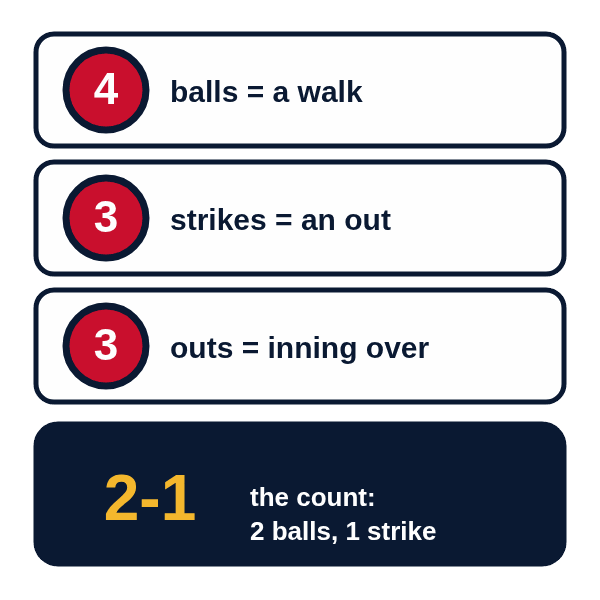
- A pitch in the strike zone, or a swing and miss. A foul ball is usually a strike too. Three strikes is an out.
- Ball
- A pitch outside the strike zone that the batter does not swing at. Four balls is a walk.
- Walk
- When the batter takes first base after four balls.
- Foul ball
- A batted ball that lands outside the foul lines.
- Bunt
- A short, soft hit made by tapping the ball with the bat without a full swing.
- Slap hit
- A fastpitch technique where a batter moves toward the pitch and hits the ball on the ground, aiming to run quickly to first.
Running terms
- Safe
- The umpire's call that a runner reached a base before being put out.
- Steal
- When a runner tries to advance to the next base on a pitch, without a hit. In fastpitch the runner may not leave until the pitcher releases the ball. Rules vary, and slowpitch usually restricts it.
- Tag up
- When a runner returns to touch their base after a fly ball is caught, then advances.
- Force out
- An out made by touching a base with the ball when a runner has to move to that base.
- Tag
- When a fielder touches a runner with the ball to record an out.
Defense terms
- Infield fly
- A rule that protects runners in certain situations by calling the batter out on an easily caught fly ball. Your coach can explain how your league applies it.
- Double play
- One play that results in two outs.
- Error
- A misplay by a fielder that allows a batter or runner to reach or advance when an out should have been made.
- Battery
- The pitcher and catcher together.
- DP/Flex
- Roles in some rule sets where a designated player bats without playing defense, often paired with a flex player on the field.
- Back up
- To position behind a teammate so a missed ball or bad throw does not go far.
Keep learning
Once you know the language, the game is easier to enjoy. Read softball positions explained to see who stands where, or visit the softball guides hub. Do not worry about learning everything at once. Most parents pick it up one game at a time, and most coaches are glad to answer questions.
A few extra tips: terms sometimes change slightly between leagues, and younger divisions may skip some rules entirely, so what you read here is a starting point. Scorekeepers also use shorthand letters and numbers for positions and plays, and you can ask the person keeping the book to explain it. Many parents find it helpful to jot down one or two unfamiliar words at each game and look them up afterward. Within a few weeks, the chatter from the dugout starts to make sense.
Listen for the words your coach uses and the calls your umpire makes, and ask when something is unclear. Players and parents who ask questions usually learn the game faster and enjoy it more.
The count and the lineup
- Count
- The number of balls and strikes on the batter, always said balls first. A count of "two and one" means two balls and one strike.
- Lineup or batting order
- The list of players in the order they bat. Many youth leagues have everyone bat, so the lineup may include the whole team.
- On deck
- The next batter, who waits near the dugout ready to step in.
- Leadoff
- The first batter in the lineup, or the first batter to come up in an inning.
- RBI
- Runs batted in. A batter gets credit for an RBI when a play they make helps a run score, in most cases.
- Sacrifice
- A bunt or fly ball that gives up the batter's turn to move a runner forward.
Types of hits
- Ground ball
- A ball hit along the ground. Also called a grounder.
- Fly ball
- A ball hit high into the air. A fly ball caught before it lands is an out.
- Line drive
- A ball hit hard on a fairly straight path, low to the ground.
- Pop-up
- A short, high fly ball that stays near the infield.
- Fielder's choice
- When a fielder picks another runner to play on instead of the batter, so the batter reaches base without a hit being credited.
Places and gear
- Dugout
- The area, usually a bench behind a fence, where the team waits when not playing.
- Base path
- The imaginary line between bases that a runner is expected to follow.
- Home plate
- The five-sided plate where the batter stands and where runs are scored.
- Batter's box
- The marked area on each side of home plate where the batter stands during a pitch.
- On base
- A batter or runner who is standing safely on a base.
- Appeal
- A request to the umpire to rule on a play, such as a runner who may have missed a base. Usually only a coach or the defense makes appeals.
Phrases you will hear shouted from the dugout
- "Good eye": praise for a batter who did not swing at a ball.
- "Two down": there are two outs.
- "Play is at first": the throw should go to first base.
- "Mine" or "I got it": a fielder calling for a ball so teammates stay clear.
- "Tag" or "Go back": a runner needs to return to a base.
- "Hustle": run hard, even on a play that looks routine.
When you want to see these terms in action, how to keep score in softball uses many of them in context, and softball umpire calls explained shows the signals umpires use for them.
In BlackForge Sports: one app for every sport your family plays, with live scores, highlights that make themselves and parent-controlled profiles. Get early access and tell us you’re here for softball. Get early access →
Sources and further reading
- Softball (summary) Encyclopaedia Britannica
- What's the Score?: The Basics of Scorekeeping Little League International
- Rule Interpretations for Little League Softball FAQs Little League International
Links open in a new tab. Quotations are short excerpts, included with attribution for commentary. BlackForge Sports is not affiliated with or endorsed by the people or organizations named.
Frequently asked questions
What does DP/Flex mean in softball?
It is a pair of roles in some rule sets. A designated player bats without playing defense, and a flex player plays defense in the field. Rules vary by league.
What is a slap hit?
A fastpitch technique where the batter moves toward the pitch and hits the ball on the ground, aiming to run quickly to first base.
What does tag up mean?
After a fly ball is caught, a runner must return to touch their base before advancing.
What is the difference between a force out and a tag out?
A force out happens when a fielder with the ball touches the base a runner must reach. A tag out happens when a fielder touches the runner with the ball while the runner is off a base.
What does the count mean in softball?
The count is the number of balls and strikes on the batter, said with balls first. For example, a three-and-two count means three balls and two strikes.