

Baseball guide
How to read a baseball box score
A box score is a one-page summary of a baseball game: who scored when, how every batter did, and how every pitcher threw. Once you know the dozen or so abbreviations, you can read a whole game in under a minute. This guide walks through each part with a made-up youth game.
The line score: runs, hits and errors by inning
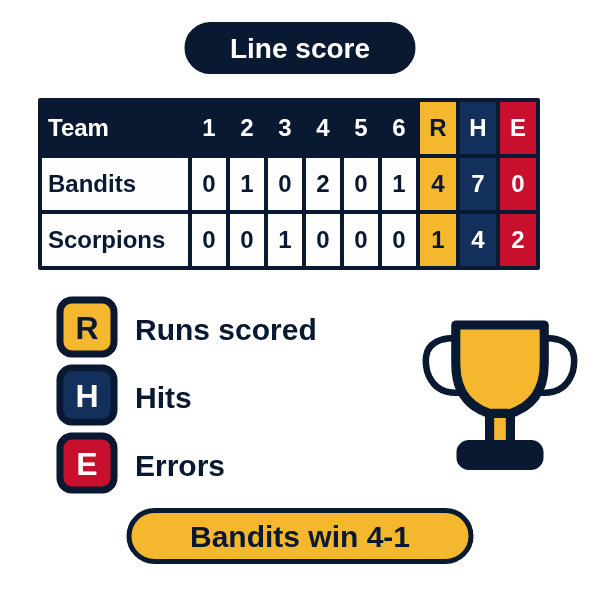
The line score sits at the top. Each row is a team, each column an inning, and the three boxes on the right are the totals: R (runs), H (hits) and E (errors).
| Team | 1 | 2 | 3 | 4 | 5 | 6 | R | H | E |
|---|---|---|---|---|---|---|---|---|---|
| Bandits | 0 | 1 | 0 | 2 | 0 | 1 | 4 | 7 | 0 |
| Scorpions | 0 | 0 | 1 | 0 | 0 | 0 | 1 | 4 | 2 |
The visiting team is listed first and bats first in every inning. Here the Bandits won 4–1 in a six-inning game. Notice the Scorpions committed two errors; that matters later when we separate runs from earned runs.
Batting lines: what each column means
Each batter gets a row. Players are listed in batting order, with their position next to the name.
| Batter | AB | R | H | RBI | BB | SO |
|---|---|---|---|---|---|---|
| J. Rivera, CF | 3 | 1 | 2 | 1 | 1 | 0 |
| T. Okafor, SS | 4 | 1 | 1 | 2 | 0 | 1 |
- AB: at-bats
- Plate appearances that count toward batting average. Walks, hit-by-pitches, sacrifice bunts, sacrifice flies and catcher's interference do not count as at-bats.
- R: runs scored
- Times this player crossed home plate.
- H: hits
- Singles, doubles, triples and home runs. Reaching on an error or a fielder's choice is not a hit.
- RBI: runs batted in
- Runs that scored because of this batter's plate appearance. Generally not credited when the batter grounds into a double play or reaches on an error, and the scorer decides close calls on errors.
- BB: walks
- Four balls. The batter takes first base.
- SO (or K): strikeouts
- Three strikes. Some box scores also add HBP (hit by pitch), SB (stolen bases) and extra-base hit columns.
Below the table, box scores usually list extras as short notes: 2B (doubles), 3B (triples), HR (home runs), SB (stolen bases), E (errors), DP (double plays) and LOB (runners left on base). For more on any abbreviation, see our baseball stats glossary.
Pitching lines: IP, H, R, ER, BB, SO
| Pitcher | IP | H | R | ER | BB | SO | Pitches |
|---|---|---|---|---|---|---|---|
| M. Chen (W) | 5.0 | 4 | 1 | 1 | 2 | 6 | 68 |
- IP: innings pitched
- Written in thirds, not decimals. 5.1 means five and one-third innings (16 outs); 5.2 means five and two-thirds.
- R vs. ER: runs and earned runs
- Every run the pitcher allowed counts as an R. An earned run is one that scored without help from an error or passed ball. If a defender's mistake kept an inning alive, runs scoring afterward may be unearned. This is why pitchers are judged on ERA, not total runs.
- Pitches (or P-S)
- Total pitches thrown, sometimes shown as pitches-strikes (for example 68-44). Youth leagues rely on this number for rest rules, so it is worth reading carefully. See our arm care guide.
- W, L, SV: decisions
- The pitcher credited with the win (W), loss (L) or save (SV). The rules for decisions differ between leagues, especially in youth ball where innings and pitcher limits vary.
How to read a whole game in 60 seconds
- Start with the line score. Who won, by how much, and in which innings did the scoring happen?
- Scan hits vs. runs. Many hits but few runs usually means runners were stranded. Check LOB.
- Look at errors. A team's errors explain unearned runs and long innings.
- Find the standout batters. Look for multi-hit games and RBI.
- Check the pitcher. Innings, strikeouts, walks and total pitches tell you how the game was controlled.
Worked example: what the sample game tells us
Put the three tables above together. The Bandits won 4–1 on 7 hits to 4, so they were the better team at the plate, but the Scorpions' two errors also gave them extra chances. If you saw the Scorpions' pitching line, some of those four runs could show as unearned, meaning R would be higher than ER.
In the batting lines, J. Rivera went 2-for-3 with a walk, a run and an RBI, so he reached base three times in four plate appearances. T. Okafor had one hit and two RBI. Between them they drove in three of the four runs. On the mound, M. Chen allowed 4 hits and 2 walks (six baserunners) over 5 innings, struck out 6 and threw 68 pitches, an average of about 13.6 pitches per inning. Only one run scored against him, and it was earned, so the Bandits' defense played a clean game (0 errors).
Other abbreviations you may see
- PA: plate appearances, which include walks and sacrifices.
- HBP: hit by pitch. The batter takes first base and it is not an at-bat.
- SB / CS: stolen bases and times caught stealing.
- WP / PB / BK: wild pitch, passed ball and balk, which let runners advance without a hit.
- LOB: runners left on base at the end of innings. A big LOB number next to a low run total tells you the team had chances and did not cash in.
- DP: double plays turned, usually followed by the fielders involved, such as 6-4-3.
Layouts differ between leagues and apps, and youth box scores often drop columns they do not track. If a column is unfamiliar, check the stats glossary before guessing. Fielders are listed by position, and you can brush up on those in our positions guide.
What a box score cannot tell you
- How hard the ball was hit. A line drive caught for an out and a weak grounder that is a hit look similar in the numbers.
- Defense beyond errors. A great catch that saves a run leaves no mark, and a ball nobody reached is just a hit.
- Who scored it. Calls such as hit versus error are judgment calls by the scorer, and youth scorers vary in experience.
- The story of the game. The play-by-play shows when the momentum turned. The box score only shows the totals.
Common mix-ups
- "5.2 innings" is not five and a fifth. The number after the dot is outs (thirds of an inning).
- A walk is not an at-bat. It does not lower a batter's average, but it does help on-base percentage.
- R and RBI are different. A batter can score without driving anyone in, and drive in runs without scoring.
- Total runs are not earned runs. Errors change the pitcher's ERA, not the final score.
Scoring your child's games? Our guide to keeping score shows how those numbers get recorded in the first place.
In BlackForge Sports: the Box tab shows every batter's line and the pitcher's numbers, the Line tab shows the inning-by-inning line score, and the Plays tab lists every play grouped by half-inning, so you can move from the summary to the play that mattered. Get early access →
Sources and further reading
- Basics: How to Score a Game MLB
- Baseball - Rules, Strategy, Stats Encyclopaedia Britannica
Links open in a new tab. Quotations are short excerpts, included with attribution for commentary. BlackForge Sports is not affiliated with or endorsed by the people or organizations named.
Frequently asked questions
What do R, H and E mean in a box score?
R is runs, H is hits and E is errors. They appear as totals at the right of the line score for each team.
What does IP 5.2 mean?
It means five and two-thirds innings, so 17 outs. The digit after the decimal point counts outs, not tenths of an inning.
What is the difference between R and ER for a pitcher?
R is every run the pitcher allowed. ER counts only earned runs, which are runs that did not score because of an error or passed ball.
Which team is listed first in a box score?
The visiting team is listed first because it bats first in each inning. The home team is listed second and bats last.
Why do walks not count as at-bats?
A walk is a plate appearance but not an at-bat, so it does not hurt a batter's batting average. It does count toward on-base percentage.