


Gymnastics guide
Gymnastics terms for new parents
Gymnastics comes with its own language, and it can feel like everyone is speaking in code. Use this glossary at practice and at meets. Terms and skill names vary by organization, so your coach is always the final word.
Meet and scoring words
- All-around
- A ranking based on a gymnast's combined scores from all of the events she or he competes. The highest total wins.
- Apparatus
- A piece of competition equipment, such as the beam, bars or rings. The plural is apparatus or apparatuses.
- Code of points
- The rulebook that tells judges how skills are valued and what deductions to take. Different organizations use different versions.
- Deduction
- Points taken off a score for a mistake, such as a bent knee, a fall or a step on a landing.
- Difficulty
- The part of a score that reflects how hard the chosen skills and combinations are.
- Execution
- How well a skill is performed, including form, body position, control and landing.
- Rotation
- A turn on one event. Groups move from event to event in a set order during a meet.
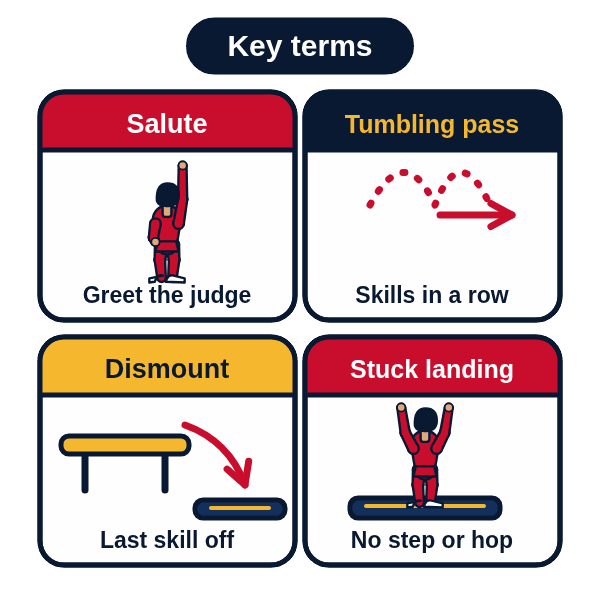
- Salute
- The gymnast raises the arms to acknowledge the judge before and after a routine.
- Compulsory (or required) routine
- A routine set by the governing body or program that every gymnast at a certain level performs. Some programs use them at certain levels.
- Optional routine
- A routine the gymnast and coach design themselves, within the rules for the level.
Skill words
- Dismount
- The final skill that gets the gymnast off an apparatus, such as a flip off a beam or bar.
- Landing
- How a gymnast finishes a skill on the mat. A controlled landing, often called a stuck or sticking the landing, is when the gymnast finishes without stepping or hopping.
- Tumbling pass
- A series of acrobatic skills performed across the floor in a row.
- Run-up
- The sprint before a vault, ending with the jump onto the springboard.
- Release
- A skill on bars in which the gymnast lets go and catches the bar again.
- Giant
- A full circle swing around the bar with the body extended.
- Handstand
- A basic skill in which the gymnast balances upside down on the hands. It is a foundation for many events.
Gym and training words
- Spotting
- A coach physically assists or stands ready beside a gymnast to help with safety and technique while learning a skill.
- Progression
- A step-by-step series of drills that builds toward a harder skill.
- Conditioning
- Strength and fitness work that helps support skills and keep gymnasts strong.
- Flexibility
- How far joints and muscles can move, which gymnasts work on through stretching.
- Grips
- Hand protection worn on certain apparatus such as bars and rings.
- Chalk
- A powder used to keep hands dry for a better hold.
- Level
- A stage in a program's skill ladder. Levels, numbering and rules differ by country and organization, so ask your gym how it works.
- Mental block
- Fear or hesitation that makes a gymnast unable to perform a skill she or he has done before. It is more common than parents realize. Talk with the coach.
A few more you will hear
- Uneven bars
- The women's event with two horizontal bars set at different heights.
- Balance beam
- The women's event performed on a narrow raised beam.
- Pommel horse
- The men's event in which the gymnast swings the legs while supporting himself on the handles and body of the horse.
- Routine
- The sequence of skills a gymnast performs on one apparatus, from start to finish.
- Mount
- The first skill of a routine, used to get onto an apparatus.
- Session
- A block of a meet in which one or more groups compete. A large meet may have several sessions.
Putting it to use
Having the vocabulary helps you ask better questions and understand the answers. If you have not yet seen a meet, read how gymnastics meets and scoring work. For a tour of each apparatus, see gymnastics events explained. All of our gymnastics articles are on the gymnastics hub.
When you hear an unfamiliar word at the gym, ask. Coaches are usually delighted to explain, and your child will pick up the language faster with a parent who is learning alongside.
Phrases you may hear from coaches
- Form
- The shape of the body during a skill, such as straight legs and pointed toes. Good form is a major part of how execution is judged.
- Spot (as a verb)
- To assist or stand ready beside a gymnast. If a coach says a skill still needs a spot, it means the gymnast is not yet working on it alone.
- Ready for the next level
- A phrase that usually means a coach feels a gymnast has the skills, strength and confidence for more. Ask what specifically your child is working on.
- Drill
- A smaller exercise that practices part of a skill, often used within a progression.
- Warm-up
- The early part of practice or a meet, designed to prepare the body and mind. At a meet, a timed event warm-up may be offered before competition begins.
Words you will hear on meet day
At a meet you may hear announcers call a gymnast's name, a team or a group. Expect words such as session, flight or group for a block of competitors, and check-in for the arrival process. Different hosts use different words for similar things, so read the meet information and ask a coach if you are unsure. If a result sheet shows abbreviations, the host or coach can explain them.
Tips for learning the language
- Pick up three or four words at a time rather than trying to memorize the list.
- Ask your child to teach you words from class. Children often enjoy being the expert.
- Remember that skill names vary by organization and country, and that a name alone does not tell you whether a skill is safe to try without a coach.
When you are ready to see these words in action, read the meet-day checklist for parents or the first-year guide.
In BlackForge Sports: one app for every sport your family plays, with live scores, highlights that make themselves and parent-controlled profiles. Get early access and tell us you’re here for gymnastics. Get early access →
Sources and further reading
- Olympic Artistic Gymnastics 101: Key terms, definitions and rules Olympics.com
- Gymnastics 101: Women's Artistic Gymnastics USA Gymnastics
- Gymnastics 101: Women's Scoring USA Gymnastics
Links open in a new tab. Quotations are short excerpts, included with attribution for commentary. BlackForge Sports is not affiliated with or endorsed by the people or organizations named.
Frequently asked questions
What does sticking the landing mean?
It means finishing a skill on the mat without taking a step or hop. It is a sign of control, and in many scoring systems a poor landing costs deductions.
What is a deduction?
A deduction is a reduction in a score for a mistake, such as a fall, a bent knee or a step on a landing.
What is spotting?
Spotting is when a coach assists or stands ready beside a gymnast while learning a skill, to help with safety and technique.
Are gymnastics levels the same everywhere?
No. Levels and rules vary by country and organization, so ask your gym how its program is structured.
What is the difference between a compulsory and an optional routine?
A compulsory routine is set by the program or governing body and performed by everyone at a level. An optional routine is designed by the gymnast and coach within the rules. Which levels use which varies by organization.
Where can I learn more gymnastics vocabulary?
Your coach is the best source, since terms vary by gym and organization. A glossary like this one helps you get started.