

Gymnastics guide
Gymnastics events explained for girls and boys
Artistic gymnastics is really several sports in one, because each apparatus asks for a different mix of strength, flexibility, courage and timing. Here is what each event is and what to look for as a parent.
Who competes on what
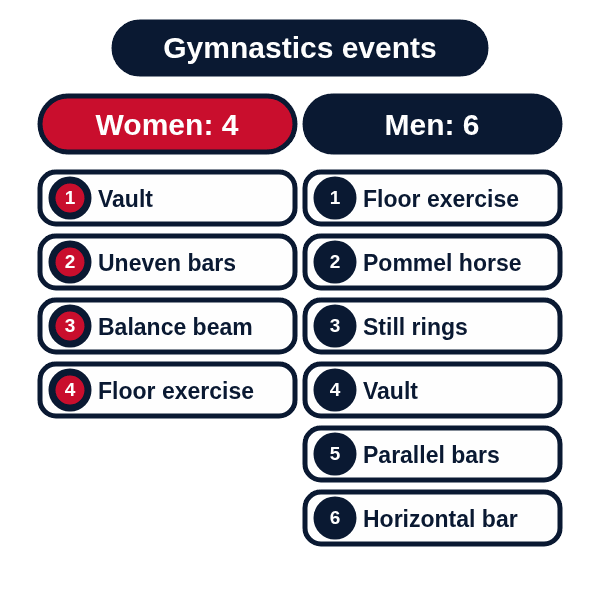
In standard artistic gymnastics, women's competition has four events and men's competition has six. Many programs for young children begin with the same basic skills for everyone, then add events as gymnasts progress. Specific events offered at beginner levels differ by gym and organization, so check with your program. This guide covers artistic gymnastics; other disciplines such as rhythmic, trampoline and tumbling, acrobatic and group gymnastics have their own apparatus and rules.
| Women's events | Men's events |
|---|---|
| Vault | Floor exercise |
| Uneven bars | Pommel horse |
| Balance beam | Still rings |
| Floor exercise | Vault |
| (No fifth event) | Parallel bars |
| (No sixth event) | Horizontal bar |
The women's events
Vault
The gymnast sprints down a runway, jumps onto a springboard, pushes off a vaulting surface with her hands and flies into a landing. Vault is fast: the whole skill takes only a few seconds, and landings are a big part of the score.
Uneven bars
Two horizontal bars set at different heights. The gymnast swings, releases, regrasps and moves between the bars. The event rewards upper-body strength, rhythm and timing. Many gymnasts wear grips to protect their hands.
Balance beam
A narrow raised beam. Gymnasts combine leaps, jumps, turns, acrobatic skills and a dismount. Beam is often described as the most mentally demanding event, because it is about balance and calm as much as skill.
Floor exercise
A routine on a large sprung floor. In women's competition, floor is performed to music and blends tumbling passes with dance and choreography. Expression and performance matter along with skills.
The men's events
- Floor exercise. Tumbling passes on the same type of sprung floor. Men's floor is performed without music and combines acrobatic passes with strength and balance elements.
- Pommel horse. The gymnast supports himself on the hands and swings the legs in circles and scissor-like movements over a horse with two handles called pommels. It demands rhythm and strong shoulders and core.
- Still rings. Two rings hang from cables. The gymnast swings and holds strength positions with the rings as still as possible. It is one of the biggest tests of upper-body strength.
- Vault. Like the women's event: run, springboard, push off and land.
- Parallel bars. Two bars side by side at the same height. The gymnast swings, supports and flies between and over them.
- Horizontal bar. A single high bar for big swings, releases and catches, finished with a dismount.
What to look for as a parent
- Progressions. Coaches teach skills in small steps with spotting and soft landing surfaces. A skill that looks easy may have taken months of drills.
- Different strengths. A child may love beam and dread bars, or the other way around. That is normal.
- Fear is normal. Nerves around new skills are expected. A good coach lets a gymnast move forward at a safe pace.
Where to go next
Once you know the apparatus, the next question is how a meet is run. See how gymnastics meets and scoring work. To make sense of the words you will hear in the gym, try gymnastics terms for new parents. The full collection lives on the gymnastics hub.
Skills that show up everywhere
Even though the apparatus look so different, the same building blocks appear again and again. Handstands, strong body shapes, jumps, rolls, cartwheels and controlled landings are taught early because they are used on every event. That is why a good beginner class spends so much time on basics such as conditioning, flexibility and body awareness. A gymnast who builds these foundations will find new events easier to learn later.
It also means a young gymnast does not need to choose a favorite event right away. Most programs let children try a bit of everything first and discover what they enjoy.
One more note: apparatus dimensions and heights are set by the governing body and by each program, and they can be adjusted for younger gymnasts. Ask your coach rather than relying on numbers you find online.
How the events differ for a young gymnast
Each apparatus asks something different of a child. Vault is quick and explosive. Bars and rings lean on grip and upper-body strength. Beam asks for balance and a calm mind. Floor blends power with body control. Because of this mix, a child who finds one event frustrating may shine on another, and coaches often rotate gymnasts through everything in early classes so that strengths and interests show up naturally.
Safety on every apparatus
Every event has real risks, and that is why coaching quality matters so much. Skills should only be attempted with a qualified coach present, with the right landing surfaces and with spotting or other support when the coach decides it is needed. Do not let children copy what they see online or at a meet on playground equipment or furniture at home. Our gymnastics safety basics for parents guide covers what to look for and what to ask.
Events at meets
At a meet, each group works through the events one rotation at a time, and scores are tracked event by event as well as in total. Some meets award event placings, some give all-around awards and some do both. Not every gymnast competes on every event at every level, so check the meet information. To see how it all fits together, read the meet-day checklist for parents, and for the other disciplines mentioned above, see artistic vs rhythmic vs trampoline gymnastics.
Questions to ask your coach about events
- Which events will my child work on this season, and why?
- How does the gym adjust equipment and surfaces for smaller gymnasts?
- What strength and flexibility work supports these events?
- What should we do, and not do, at home between classes?
In BlackForge Sports: one app for every sport your family plays, with live scores, highlights that make themselves and parent-controlled profiles. Get early access and tell us you’re here for gymnastics. Get early access →
Sources and further reading
- Gymnastics 101: Women's Artistic Gymnastics USA Gymnastics
- Gymnastics 101 USA Gymnastics
- Gymnastics Encyclopaedia Britannica
- Olympic Artistic Gymnastics 101: Key terms, definitions and rules Olympics.com
Links open in a new tab. Quotations are short excerpts, included with attribution for commentary. BlackForge Sports is not affiliated with or endorsed by the people or organizations named.
Frequently asked questions
How many events are there in girls' gymnastics?
In standard artistic gymnastics, women compete on four events: vault, uneven bars, balance beam and floor exercise.
How many events are there in boys' gymnastics?
In standard artistic gymnastics, men compete on six events: floor exercise, pommel horse, still rings, vault, parallel bars and horizontal bar.
Do beginners do every event?
Not always. What a young gymnast does depends on the gym, the class and the level, so ask your coach which events are part of the program.
Which event is the hardest?
It depends on the gymnast. Some find beam mentally tough, others find strength events such as rings or bars the biggest challenge.
Is it safe to practice gymnastics skills at home?
Skills should be learned with a qualified coach, proper surfaces and spotting where needed. Ask your coach what, if anything, is appropriate at home, and avoid copying skills from videos.
Do boys and girls train the same way at first?
Many beginner programs teach the same basic skills to everyone, then add events as gymnasts progress. Ask your gym how its classes are structured.