

Baseball guide
Youth baseball equipment checklist
Starting baseball means a surprising amount of gear. This checklist covers what most youth players need, what is optional, and what to check with your league before you buy.
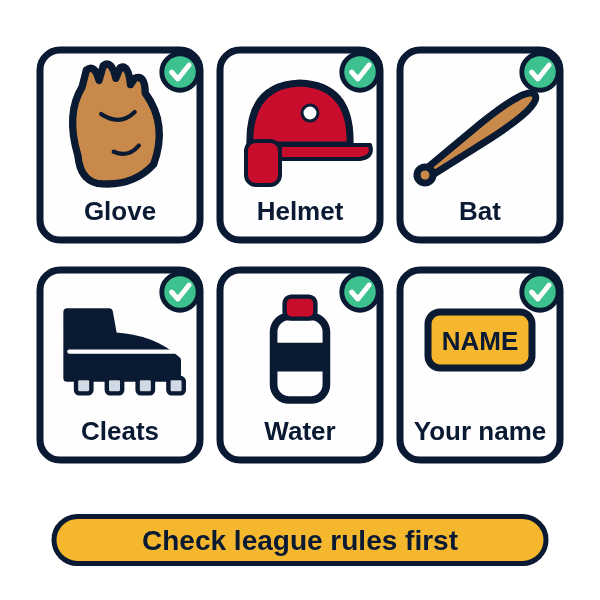
Check your league's rules first. Leagues set requirements for bats, helmets, cleats and protective gear. Many provide team items like uniform tops and catcher's gear.
The essentials
- Glove: sized for your child's hand. A glove should be snug but not hard to close. Younger players often do well with a smaller, softer glove.
- Batting helmet: required in nearly every league. Look for the NOCSAE certification, a proper fit, and a face guard if your league requires or recommends one.
- Bat: use one approved by your league. See bat standards and sizing.
- Cleats: molded rubber or plastic cleats are standard for youth players. Many leagues prohibit metal cleats at younger ages.
- Baseball pants and belt, and team jersey and cap as specified by your team.
- Protective cup or supporter: commonly required or strongly recommended.
Often helpful
- Batting gloves, for grip and comfort.
- A mouthguard.
- Sunglasses or a visor-friendly cap, sunscreen.
- Spare socks and a clean shirt, for tournament days.
- A bat bag or backpack with a spot for the glove and helmet.
Catcher's gear
Catchers need a catcher's helmet with mask (many leagues require an attached or hanging throat guard), a chest protector, leg guards, a protective cup, and a catcher's mitt. Many teams share a set, but a personal fit matters for comfort and safety. Look for NOCSAE-certified helmets, and ask your league what it requires.
What to bring to every game
- Glove, helmet and bat, with the player's name on them.
- Water bottle and a snack.
- Weather gear: sunscreen, hat, a light jacket or rain layer.
- Schedule and directions, and your team's contact info.
Getting the right fit
- Helmet: should sit level on the head, snug but not tight, with the chin strap or face guard (if used) properly adjusted. A helmet that wobbles or slides over the eyes is the wrong size.
- Glove: your child should be able to open and close it with one hand. Many parents buy too large a glove, but a glove that is too big is harder to control.
- Cleats: leave a little room for growth but not so much that the foot slides. Try them on with game socks.
- Pants: kids grow fast, so check length before the season starts.
Buying smart
- Ask the league first. Many leagues loan helmets, catcher's gear and sometimes bats.
- Buy the glove and cleats first. These are the most personal items.
- Look for used gear from local families, but avoid used helmets with cracks or missing padding, and check bats for dents.
- Wait on the bat until you know what your league allows. See bat standards and sizing.
- Skip the extras until your child has played a few weeks and you know what they need.
What different ages usually need
At t-ball and coach pitch, most leagues need only a glove, helmet and cleats or sneakers, and the league often provides bats and helmets. As kids move into player-pitch divisions they typically add a personal bat, a cup, and batting gloves. Players interested in catching or pitching may need extra gear. Requirements vary, so read your league's handbook.
Packing the bag
A simple routine helps: pack the bag the night before, check the weather, and have your child put in their own gear so they learn to be responsible for it. For tournament weekends, see the tournament packing list.
Safety basics
- Helmets should be worn by batters and runners, and by anyone your league requires, such as base coaches or catchers.
- Do not wear jewelry or hard items that could injure a player or others.
- Check that cleats and glove laces are in good shape before each season.
- Use gear for its intended purpose. A catcher's mask is not a substitute for a batting helmet.
- If a piece of gear is damaged or does not fit, ask a coach or league official before the next game.
Gear for specific positions
Most positions use the same basics. Infielders often prefer a smaller glove for quick transfers, and outfielders a longer one for reaching fly balls. First basemen have a specially shaped glove, and catchers have their own mitt. Pitchers should not wear anything on the glove hand that could distract a batter, depending on league rules. Before spending money on a specialty glove, see which positions your child enjoys by reading baseball positions explained.
Questions to ask your league
- Which bats are legal, and does the league provide any?
- Is a cup required, and at what ages?
- Are cleats required, and which types are allowed?
- What uniform pieces does the team provide, and what do we buy?
- Who provides catcher's gear and helmets?
Common gear mistakes
- Buying a bat before checking league rules.
- Choosing gear that is too big so it will last. Oversized gear is harder to use and can be less safe.
- Forgetting to label gear, which leads to mix-ups in a crowded dugout.
- Waiting until the morning of the first game to find out something is missing.
Taking care of gear
- Keep gloves dry and store them with a ball in the pocket.
- Check helmets for cracks and replace damaged ones.
- Inspect bats for dents or cracks and retire damaged bats.
- Label everything. Kids lose gear.
Try before you buy
Fit matters more than brand. Have your child try on the glove, helmet and cleats in person when you can, and make a few catches or swings in the store if it allows. Ask your coach or league whether there is a gear swap, loaner program or used-equipment sale. Growing players outgrow gear quickly, so used items in good condition are often a sensible choice, except for helmets with cracks or other damage, which should be replaced. For a positional view of what each player needs, see baseball positions explained.
Ready for the season? See how to prepare for tryouts and our tournament packing list.
Sources and further reading
- Appendix B - Safety Code for Little League Little League International
- Appearance of Little Leaguers Little League International
- Baseball and Softball HealthyChildren.org (American Academy of Pediatrics)
Links open in a new tab. Quotations are short excerpts, included with attribution for commentary. BlackForge Sports is not affiliated with or endorsed by the people or organizations named.
Frequently asked questions
What equipment does a youth baseball player need?
A glove, a league-approved bat, a batting helmet, cleats, baseball pants, a team jersey and cap, and a protective cup. Catchers need additional protective gear.
Do kids need their own helmet?
Many teams provide shared helmets, but a personal helmet fits better and is more hygienic. Look for NOCSAE certification.
Can kids wear metal cleats?
Many youth leagues prohibit metal cleats at younger ages, so check your league's rules.
How should a baseball glove fit?
Snug on the hand, with the fingers reaching the ends of the finger stalls, and easy enough for your child to close.
What size baseball glove does a youth player need?
Sizes vary by age, position and brand, so try gloves on if you can and ask your coach. The best glove is one your child can close easily and control.
Does my child need a cup?
Many leagues require or strongly recommend a protective cup, especially for catchers and in older divisions. Check your league's rules.