

Wrestling guide
Wrestling tournament day guide for parents
Your child's first wrestling tournament is a big day for the whole family. This guide walks through brackets, check-in, the flow of the day and what to bring, so you can stay calm and help your child enjoy it.
What a wrestling tournament looks like
A wrestling tournament is a long day built from short matches. A child may wrestle only a few minutes in total, yet the event can fill much of a day because many wrestlers share a limited number of mats. The best preparation for a parent is patience, a packed bag and a calm plan. If you are new to the sport, read wrestling rules for beginners first so the matches make sense.
Every event is organized a little differently. The number of mats, the number of matches per wrestler, and the schedule vary by host and age group, so always read the information the organizers send.
How brackets work
Wrestlers are grouped by age and weight, and sometimes by experience, so that opponents are reasonably matched. Within a group, the event uses one of a few common formats.
- Single elimination
- A wrestler who loses is out of the bracket. This is simple but can mean a short day for some wrestlers, so many youth events add a way to keep wrestling.
- Double elimination
- A wrestler is out only after a second loss. Wrestlers who lose may continue in a consolation bracket and wrestle for a lower placing.
- Round robin
- Every wrestler in a small group wrestles each of the others, and placings come from results. This is common when a bracket is small.
- Guaranteed matches
- Some beginner and youth events promise each child a certain number of matches. Check the event flyer to see if yours does.
Check-in and weigh-ins
Most events have a check-in or weigh-in so wrestlers can be placed in the right group. The time, the clothing allowed and the rules for weighing in vary by event. Read the flyer and ask your coach what to expect. Weight is a topic to treat with care for young athletes. Your child should eat and drink normally, and any questions about weight or nutrition belong with a doctor, not a social media thread. Our guide to weight classes and positions explains how classes work in general terms.
How the day usually flows
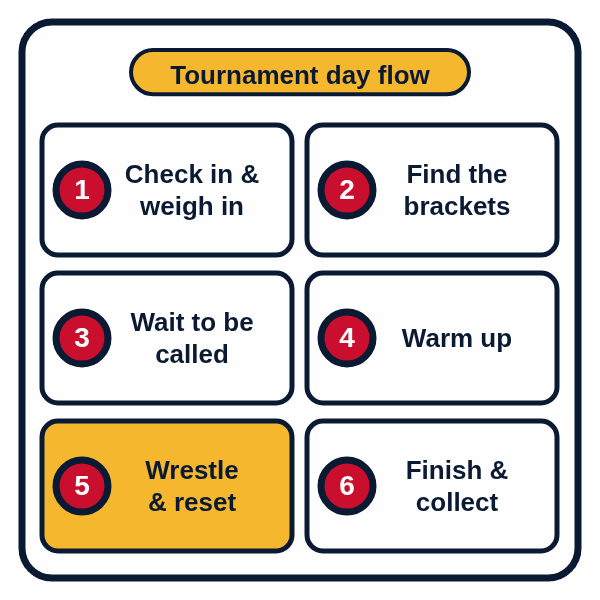
- Arrive and check in. Find your team area, confirm your child's name and group, and complete weigh-in if there is one.
- Find the brackets. Brackets are often posted on a wall or shown on a screen or an app. Look for your child's group and note the first mat.
- Wait to be called. Mat workers call bouts, often a few at a time. Your child needs to be ready near the right mat when the call comes. The coach usually manages this, and parents should check with the coach before wandering off.
- Warm up. The coach guides a light warm-up before a match.
- Wrestle and reset. After a match, give your child a moment, a drink of water and a calm word. Then the waiting begins again.
- Finish and collect. Awards, if any, are handed out after the group finishes. Stay until your child's group is done.
What to pack
- Your child's required gear and a spare of anything that matters, as listed in our youth equipment checklist.
- Water and easy, familiar snacks that your child already eats. A tournament day is not the time to try new foods.
- A towel, a change of clothes and a warm layer for waiting between matches.
- A folding chair or blanket and a small bag for your own comfort, since gym floors and bleachers get tiring.
- Any paperwork or membership cards the event asks for.
Your role in the stands
Your job is to be the calm, steady person in your child's day. Cheer for effort and good sportsmanship. Let the coach coach, and avoid shouting instructions that conflict with what the coach says. Wrestlers often hear only the coach and the referee, and extra voices can confuse them. Never argue with officials. If you have a concern, bring it to your coach or the event organizer later.
A loss is part of the day. Wrestling teaches resilience because every wrestler, including the best ones, loses matches. Try asking, "What did you like about that match?" before you talk about results.
After the event
Make sure your child rests, eats and drinks normally. If your child seems hurt or unwell, contact a doctor. Skin conditions can spread in contact sports, so shower soon after the event, wash gear and clothes, follow your club's guidance on hygiene and ask a doctor about any rash or sore before your child returns to the mat. For a longer look at getting ready for the whole year, see how to prepare for wrestling season, and for common calls during matches see our guide to penalties and illegal moves. The wrestling hub page lists everything in one place.
Tips for a first tournament
- Read the flyer twice. Check-in time, location, fees, spectator rules and what to bring are usually listed.
- Arrive early and learn the layout. Find the check-in table, the mats, the restrooms and your team area before the first match.
- Stay close to the coach. Bouts can be called quickly, and your child needs to be ready when called.
- Keep expectations small. For many beginners, finishing the day, making friends and learning from each match is a great result.
- Respect the space. Keep walkways and areas near the mats clear, and follow instructions from event staff.
Words you may hear at the table
- Bout number
- The number that identifies a match on the schedule, often called out when it is time to get ready.
- On deck
- The wrestlers who are next to wrestle on a mat and should be ready to step on.
- Seed
- A ranking used to place wrestlers in the bracket. Many youth events place beginners without seeds, and practices vary by host.
- Bye
- A round in which a wrestler does not have an opponent and moves on without wrestling.
Common parent mistakes
- Wandering off when the bout is about to be called.
- Offering new or heavy foods that your child is not used to.
- Giving technical instructions that conflict with the coach.
- Judging the day by medals alone. Ask your child what they learned and what was fun.
For official terms, see wrestling terms for new parents.
In BlackForge Sports: one app for every sport your family plays, with live scores, highlights that make themselves and parent-controlled profiles. Get early access and tell us you’re here for wrestling. Get early access →
Sources and further reading
- What to Expect as a First Time Wrestling Parent USA Wrestling
- Wrestling Rules Interpretations - 2025-26 NFHS
- Athletes: MRSA Prevention and Control CDC
Links open in a new tab. Quotations are short excerpts, included with attribution for commentary. BlackForge Sports is not affiliated with or endorsed by the people or organizations named.
Frequently asked questions
How long does a wrestling tournament last?
It varies by event, number of mats and number of wrestlers. Many tournaments take much of a day, so plan for plenty of waiting between short matches.
What is a consolation bracket?
It is a bracket for wrestlers who have lost in a double-elimination event, giving them more matches and a chance to place. Not every event uses one, so check the flyer.
What should my child eat on tournament day?
Stick to familiar foods and water your child already handles well, and avoid trying anything new. For questions about nutrition or weight, ask a doctor.
Can parents go on the mat or coach from the stands?
Parents should stay off the mat area and leave coaching to the coach. Cheer for effort and good sportsmanship instead.
What is a bye in a wrestling bracket?
A bye means a wrestler has no opponent in that round and moves on without wrestling. It usually happens when a bracket does not have an even number of wrestlers.