


Wrestling guide
Wrestling terms for new parents
Wrestling has its own vocabulary, and it can feel like a different language at your first meet. Keep this glossary handy. Terms and scoring details can vary slightly by rule set, so ask your coach if something sounds different.
The basics
These are the words you will hear at almost every practice and match.
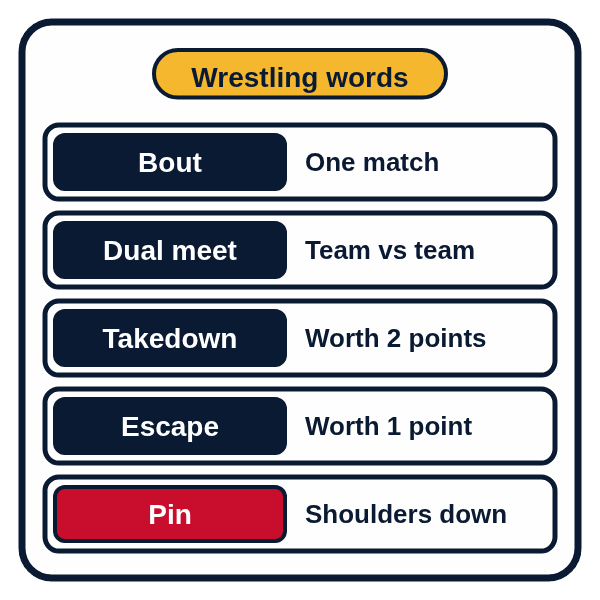
- Bout
- Another word for a single match between two wrestlers.
- Dual meet
- A competition between two teams, where wrestlers of the same weight class face one another and the results combine into a team score.
- Tournament
- An event with many wrestlers in brackets by weight and age or experience group. Wrestlers may have several matches in a day.
- Weight class
- The bracket a wrestler competes in, based on weight, so opponents are of similar size.
- Weigh-in
- The official weighing of wrestlers before competition to confirm their class.
- Folkstyle
- The style of wrestling used in American high school and college programs and in many youth programs.
- Period
- A timed segment of a match. How many and how long varies by league.
Positions
- Neutral
- Both wrestlers are standing and neither has control.
- Top
- The wrestler in control above the opponent on the mat.
- Bottom
- The wrestler beneath, trying to get free or reverse.
- Referee's position
- The starting position for some periods, with one wrestler on hands and knees and the other on top.
Scoring terms
- Takedown
- Taking the opponent from standing to the mat and gaining control. Three points in current NFHS high school rules, and other rule sets can differ.
- Escape
- Getting free from the bottom position and back to neutral. One point.
- Reversal
- Going from the bottom to control on top. Two points.
- Near fall
- Holding the opponent's back close to the mat for a set time. Points depend on the rule set and the time held.
- Pin (fall)
- Holding both of the opponent's shoulders to the mat for the required time. It ends the match.
- Technical fall (tech fall)
- A match that ends early because one wrestler leads by a large enough margin, as set by the rules in use.
- Decision
- A win on points when the match ends without a pin.
- Overtime
- Extra time used to break a tie.
Actions and calls
- Stalling
- Avoiding wrestling, for example by backing away or not engaging. It can lead to warnings and penalty points.
- Riding
- Staying in control on top of an opponent. Some rule sets award credit for it, and others do not.
- Sprawl
- A defensive move where a wrestler throws the legs back to stop a takedown attempt.
- Shot
- An attack on the opponent's legs, usually to score a takedown.
- Out of bounds
- When wrestling action leaves the circle on the mat and the referee stops and restarts the action.
- Illegal hold
- A move that is banned because it could injure a wrestler. The referee stops the match if one occurs.
Where to go next
A good habit at your first few meets is to pick one term at a time and listen for it. Try spotting a takedown in the first match, an escape in the second and a stalling warning if one happens. Naming what you see makes the sport easier to follow, and your child will enjoy explaining it to you on the ride home.
Terms and point values can differ a little between youth, high school and college rule sets, so treat this glossary as a starting point and ask your coach or league for its rulebook. Put the words in context with wrestling rules for beginners and learn how matches are structured in weight classes and positions explained. Do not hesitate to ask your coach, because most wrestling parents are happy to explain what they have learned.
Words you will hear from the stands
You will also hear coaches and fans calling out short instructions, such as "hips," "head up," "hand fight" or "get off your back." These are reminders about technique, and they change from coach to coach, so do not worry about memorizing them. If you are unsure what a referee's signal means, watch the scorer's table, where points are tracked, or ask a team parent who has been through a season. Over the course of a few meets, the language will start to feel natural.
More terms you may hear
- Stance
- The balanced ready position wrestlers use on their feet, with knees bent and hips low.
- Hand fighting
- The battle for hand position in neutral, where each wrestler tries to control the other's arms and set up an attack.
- Single-leg and double-leg
- Two common leg attacks used to try for a takedown. A single-leg attacks one leg and a double-leg attacks both.
- Stand-up
- A way for the bottom wrestler to rise to their feet and work toward an escape.
- Cradle
- A hold used from the top to turn an opponent and work toward a near fall or pin. Coaches teach it with care, and its use depends on the rules and level.
- Consolation bracket
- A bracket in some tournaments where wrestlers who have lost can keep competing for a lower placing.
- Seed
- A ranking used to place wrestlers in a bracket, so strong wrestlers do not all meet in the first round.
- Forfeit
- A win awarded when the opponent does not wrestle, for example if there is no wrestler in that class.
- Injury default
- A result when a wrestler cannot continue because of an injury, as decided by the officials and medical staff.
Terms that are easy to mix up
- Escape vs reversal: an escape gets you free to neutral, and a reversal puts you in control on top.
- Pin vs near fall: a pin ends the match, while a near fall is a point-scoring hold that falls short of a pin.
- Dual meet vs tournament: a dual meet is team against team, while a tournament is many wrestlers in brackets.
- Win by decision vs tech fall: a decision is a win on points at the end, and a tech fall ends the match early because of a large lead.
To see these words in action at an event, read the tournament day guide for parents, and for the calls referees make, see penalties and illegal moves explained.
In BlackForge Sports: one app for every sport your family plays, with live scores, highlights that make themselves and parent-controlled profiles. Get early access and tell us you’re here for wrestling. Get early access →
Sources and further reading
- Glossary of Wrestling Terms USA Wrestling
- How a college wrestling match is scored NCAA
- What to Expect as a First Time Wrestling Parent USA Wrestling
Links open in a new tab. Quotations are short excerpts, included with attribution for commentary. BlackForge Sports is not affiliated with or endorsed by the people or organizations named.
Frequently asked questions
What is a takedown in wrestling?
A takedown is when a wrestler takes the opponent from standing to the mat and gains control. It is worth three points in current NFHS high school rules, and other rule sets can differ.
What is the difference between an escape and a reversal?
An escape gets the bottom wrestler free and back to neutral. A reversal puts the bottom wrestler in control on top.
What does tech fall mean?
A technical fall ends the match early when one wrestler leads by a big enough point margin. The margin depends on the rule set.
What is stalling?
Stalling is avoiding wrestling or not trying to score. Referees give warnings and may award penalty points to the opponent.
What is the difference between a dual meet and a tournament?
A dual meet is a competition between two teams, where wrestlers in the same weight class face each other. A tournament has many wrestlers in brackets and they may wrestle several times in a day.