


Baseball guide
Rec ball vs. travel ball: how to choose for your child
Most families face this question at some point: stay in the local rec league, or try travel (also called select, club or tournament) baseball. There is no single right answer. This guide lays out the real differences and gives you questions to ask before you decide.
The basic difference
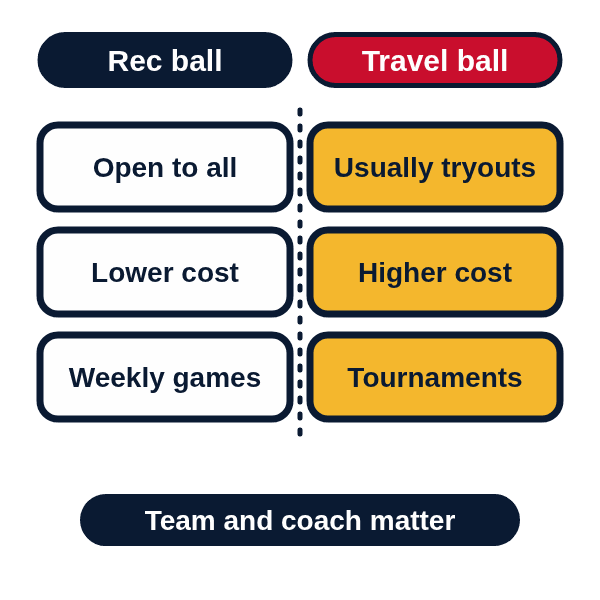
| Rec / community league | Travel / select / club | |
|---|---|---|
| Who plays | Open to any child in the area. | Usually tryouts or an invitation. |
| Schedule | Weekly games and practices, a defined season. | More games, often in weekend tournaments, sometimes with long travel. |
| Cost | Typically lower fees. | Typically higher: team fees, tournaments, travel, equipment. |
| Coaching | Often volunteer parents. | Often more experienced or paid coaches, but it varies a lot. |
| Competition | Mixed skill levels. | Generally more competitive. |
| Playing time | Often balanced by league rules. | Depends on the team; not guaranteed. |
These are tendencies, not rules. Some rec leagues are very competitive, and some travel teams are very relaxed. Judge the specific team and coach, not the label.
Myths and facts
- Myth: travel ball is required to get better. Fact: good coaching, plenty of repetitions and a love of the game matter most, and those can be found in either setting.
- Myth: more games always means more development. Fact: games are not the same as practice. A schedule packed with tournaments can mean fewer chances to work on skills and more fatigue.
- Myth: rec ball is only for beginners. Fact: many strong players stay in community leagues, often alongside school or other teams.
- Myth: a team's name or uniform tells you its quality. Fact: ask about the coach, the practice plan and how players are treated.
Start with your child
- What does your child want? A kid who loves the game but is not ready for a tournament schedule may thrive in rec ball.
- Skill and readiness. Is your child hungry for more challenge, or still building confidence?
- Friends and fun. Playing with friends and enjoying practice matters more than most adults remember.
- Other sports and downtime. Many youth sports guidelines encourage playing more than one sport and taking real breaks from baseball.
Then consider your family
- Time: practices, weekend tournaments, travel, and siblings' schedules.
- Money: ask for a full cost breakdown: fees, uniforms, tournament entries, travel, hotels.
- Logistics: where games are, who drives, and what a typical weekend looks like.
- Sanctioning and insurance: ask which organization the team plays under and what coverage the team or league carries.
Look closely at the cost
Travel costs add up in ways that are easy to miss. Ask for the full season in writing and check each of these:
- Team fee, and whether it is paid up front or in installments.
- Uniforms, bags, helmets and any required equipment. See our equipment checklist for what a player really needs.
- Tournament entry fees, and whether they are included.
- Travel, hotels, meals and gas for a typical weekend, plus any events that are far away.
- Refund policy if your child is injured or the family needs to leave.
What to expect at a tryout
Tryouts usually test throwing, fielding, hitting and sometimes speed, and coaches also watch attitude and listening. Ask in advance what the evaluation looks like and when you will hear back. Preparing helps; see how to prepare for baseball tryouts. Teams differ in how they treat players who are not selected, so ask whether there are other teams or practice groups in the organization.
Questions to ask any team before you commit
- How many games and practices per week, and for how many months?
- What is your pitching and rest policy? A good coach can explain how they track pitch counts and follow league rules.
- What is your playing-time philosophy? Equal time, earned time, or something else? Get it in plain words.
- How do you communicate with parents? Schedules, changes and feedback should be clear.
- What does the full season cost? Ask what is and is not included.
- What happens if my child needs a break, or the fit isn't right?
Red flags worth noticing
- Pressure to play year-round or to skip rest for one more tournament.
- Pitchers asked to throw through pain or fatigue.
- Pushing one position or specializing in baseball at a very young age.
- Vague answers about cost, playing time or pitch counts.
- Children pitching for more than one team at the same time with nobody tracking the total. Youth pitching guidance such as MLB and USA Baseball's Pitch Smart generally advises caution here, so check current guidance and your league's rules.
Options in between
The choice is not always rec or travel. Depending on where you live, there may be school teams, league all-star teams chosen from a rec league, lower-level or less intensive club teams, and camps or clinics. Ask your league or local coaches what is available. These can be a good step if you want more challenge without a full travel schedule.
Can my child do both?
Many families combine a rec season with a few travel tournaments, or play on a school or rec team in spring and travel in summer. If your child plays for more than one team, keep a single running record of games played and, for pitchers, pitches thrown, so the workload across teams adds up. See our arm care guide and the pitch count rules guide.
Talk it through with your child
Before you commit, sit down with your child and ask open questions: What do you like most about baseball? Would you rather play more games or have more time for friends and other activities? How would you feel about a weekend away from home? Their answers are often more useful than any comparison table. Remember too that the decision is reversible. Plenty of players move between rec and travel over the years as their interests, schedules and skills change.
A simple way to decide
If your child is enjoying rec ball and still learning, stay. If they are ready for more and your family has the time and budget, try a travel team for one season with clear expectations, and ask your child at the end how it felt. You can always change.
In BlackForge Sports: a player has one parent-controlled profile, with stats and arm workload built from scored games, so a family has a single place to follow the season. Teams, privacy and follow requests are all managed by parents. Get early access →
Sources and further reading
- Travel Teams Little League International
- Regular Season to Tournament: Rule Differences Little League International
- Mandatory Play: What Parents Need to Know Little League International
Links open in a new tab. Quotations are short excerpts, included with attribution for commentary. BlackForge Sports is not affiliated with or endorsed by the people or organizations named.
Frequently asked questions
What is the difference between rec ball and travel ball?
Rec (community) leagues are open to local children with a shorter, simpler schedule and lower cost. Travel (select or club) teams usually require tryouts and play more games, often in tournaments, at higher cost and time commitment.
What age should a child start travel baseball?
There is no single right age. Readiness depends on your child's interest, skill, and your family's time and budget. Many families wait until their child clearly wants more competition.
Is travel baseball worth the money?
It depends on your child and your family. Weigh the full cost, the time and the coaching quality against what your child wants from the game. Many children develop and enjoy the sport fully in a community league.
What should I ask a travel baseball coach?
Ask about the schedule, total cost, playing-time philosophy, communication, and how they track pitch counts and rest.
Can my child play rec and travel at the same time?
Many do. Keep track of total games and pitches across both teams so workload does not add up unnoticed.