


Baseball guide
How to keep score in baseball: a beginner's guide
Keeping score looks intimidating until you learn two things: every fielder has a number, and every play has a short code. This guide covers the basics you need to score a youth baseball game on paper or in an app.
Step 1: Learn the position numbers
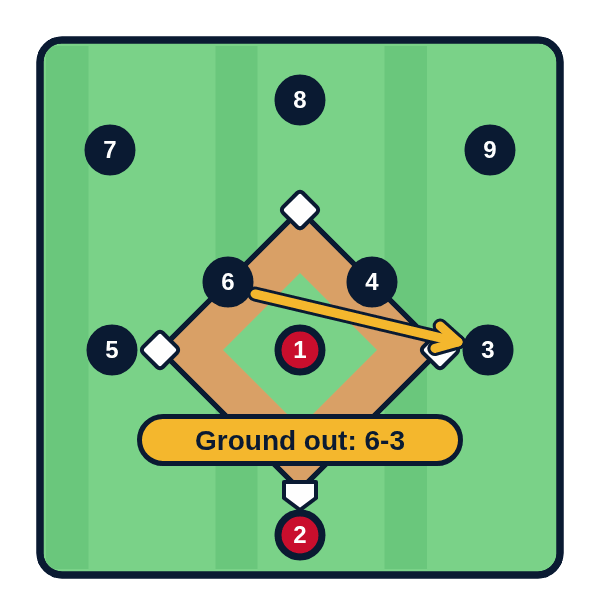
Scorekeepers write plays using the number of each defensive position.
| # | Position | # | Position |
|---|---|---|---|
| 1 | Pitcher | 6 | Shortstop |
| 2 | Catcher | 7 | Left field |
| 3 | First base | 8 | Center field |
| 4 | Second base | 9 | Right field |
| 5 | Third base | ||
A ground ball to shortstop thrown to first for the out is written 6-3: the ball went from the 6 to the 3. If you are not sure what each fielder does, see baseball positions explained.
Step 2: Learn the common symbols
| Result | Symbol | Notes |
|---|---|---|
| Single / double / triple / home run | 1B, 2B, 3B, HR | Often drawn by shading the path to that base. |
| Walk | BB | Intentional walk is IBB. |
| Hit by pitch | HBP | Batter takes first. |
| Strikeout swinging | K | |
| Strikeout looking | Ꝁ (backwards K) | Some scorers write K with a line or circle. If the catcher drops the third strike and the batter reaches, it is still a strikeout but not an out. |
| Groundout | 6-3, 4-3, 5-3… | List fielders in order they touched the ball. A play made entirely by one fielder, such as a first baseman fielding a grounder and stepping on the bag, is often written 3U (unassisted). |
| Flyout | F8, F9… | F plus the fielder who caught it. |
| Line out / pop-up | L6, P4… | Some scorers use F for all of them. |
| Fielder's choice | FC | Fielder chooses to retire another runner. |
| Error | E6, E4… | E plus the fielder who made the error. |
| Double play | 6-4-3 DP | List every fielder in order. |
| Sacrifice bunt / fly | SH (or SAC), SF | Not an at-bat. |
| Stolen base / caught stealing | SB, CS | CS often with the throw, such as CS 2-6. |
| Wild pitch / passed ball / balk | WP, PB, BK | Runners advance on the play. |
Step 3: Follow a simple routine
- Before the game: write both lineups in batting order with positions and jersey numbers. Use pencil.
- Each plate appearance: record the result in the batter's box for that inning. Mark balls and strikes if you track pitches.
- Track the runners: draw how each runner advanced (by hit, walk, steal or on a teammate's out) and mark when they score.
- Count the outs: write a number 1, 2 or 3 in the box when an out is recorded, so you always know the count.
- Substitutions: note who replaced whom and when.
- End of each inning: total runs, hits, errors and runners left on base.
Walkthrough: scoring one inning
Here is a simple inning, play by play, so you can see how the codes fit together.
- The leadoff batter grounds to the shortstop, who throws to first. Write 6-3 and put a 1 in the corner of the box for the first out.
- The next batter lines a single to left field. Write 1B and shade the path to first base. The runner is now on first.
- The third batter swings and misses at strike three. Write K and mark the second out.
- The fourth batter flies out to center field. Write F8 and mark the third out. The runner on first is left on base.
The inning total is 0 runs, 1 hit, 0 errors and 1 left on base. It also passes the math check below: four batters came to the plate, which equals 0 runs plus 1 runner left on base plus 3 outs.
Track pitches too
In youth baseball the pitch count matters as much as the score. Keep a separate tally for each pitcher: a mark per pitch, grouped in fives, with the running total at the end of each inning. Leagues use pitch counts to set daily limits and required rest, so have a second person confirm the official count when you can. See our arm care guide for why this matters.
Check your math
A classic scorebook check: for each team, plate appearances = runs + runners left on base + outs. If those do not add up, a play was recorded wrong, and the mismatch usually tells you which inning to re-check. Also confirm that hits and errors on the line score match your batters' rows.
Scoring tricky plays
- Hit or error? The official scorer decides. An error is a misplay that a fielder using ordinary effort should have made. When a play is truly close, scorers commonly lean toward crediting the batter with a hit.
- Fielder's choice. With a runner on first, a grounder is fielded and thrown to second for the force. Write the runner's out (for example 6-4) and mark the batter FC. The batter is not credited with a hit, and the play counts as an at-bat.
- Double play. Record every fielder in order (6-4-3 DP) and mark two outs. Show where each runner was retired.
- Dropped third strike. In standard rules, if the catcher does not cleanly hold strike three, the batter may run when first base is open or there are two outs. If the batter is thrown out, score K 2-3. If the batter reaches, it is still a strikeout for the pitcher and the batter reaches on a WP or PB. Many youth leagues change or turn off this rule, so check yours.
- Caught stealing. Write CS and the throw, such as CS 2-6 when the catcher throws to the shortstop covering second.
- Pinch runners and substitutes. Write the new player's name in the lineup beside the player replaced and mark the inning and point of the change. Check your league's rule on courtesy runners.
- Runs charged to pitchers. If a pitcher is replaced with runners on base, those runners are charged to the pitcher who put them there.
Paper book or app?
A paper scorebook works anywhere, needs no battery and is a good way to learn the codes. An app does the arithmetic, builds the box score and stats for you, and lets the whole family follow the game. Many parents use an app as the main record and keep a pencil book as a backup. Whichever you pick, the habits are the same: follow every play, count the outs, and check your math at the end of each inning. When you are done, reading the box score is the payoff.
Tips for scoring youth games
- Ask about local rules. Run limits per inning, time limits, dropped third strikes and courtesy runners differ by league.
- Don't chase perfection. If you miss a play, fill in the result from the next batter's situation and fix it between innings.
- Keep the official book. One person is the official scorer. Others can keep a backup.
- Review the box score together afterward. It is a great way to talk about the game with your player. See how to read a baseball box score.
In BlackForge Sports: you can set up a game by name or say the matchup out loud, then score by tap or by voice. Box scores, the line score and each player's stats are built from the plays you enter, with no end-of-game math. Get early access →
Sources and further reading
- Basics: How to Score a Game MLB
- Baseball - Rules, Strategy, Stats Encyclopaedia Britannica
Links open in a new tab. Quotations are short excerpts, included with attribution for commentary. BlackForge Sports is not affiliated with or endorsed by the people or organizations named.
Frequently asked questions
What do the numbers mean in a baseball scorebook?
They are position numbers: 1 pitcher, 2 catcher, 3 first base, 4 second base, 5 third base, 6 shortstop, 7 left field, 8 center field, 9 right field. A play written 6-3 is a ground ball fielded by the shortstop and thrown to first base.
How do you score a strikeout looking?
Most scorers write a backwards K. A strikeout swinging is a regular K.
What is a fielder's choice?
A play where the fielder chooses to get out another runner instead of the batter, so the batter reaches base without being credited with a hit. It is scored FC.
How do you check that a scorebook adds up?
For each team, plate appearances should equal runs plus runners left on base plus outs. If they do not, a play was recorded wrong, and the mismatch tells you which inning to re-check.
Can I keep score on a phone instead of paper?
Yes. Apps handle the math, stats and box score for you. Paper still works well as a backup.