

Cross country guide
Cross country terms for new parents
Cross country has its own vocabulary, and it can feel like a different language at your first meet. Use this glossary to follow along. Terms are grouped loosely, and you can jump to any word using the list below.
Race day terms
- Meet
- A cross country event where several teams compete. A meet may include several races, grouped by age, level or gender.
- Invitational
- A larger meet hosted by one team that invites others. Often has many races over a long day.
- Bib
- A numbered piece of cloth or paper pinned to a runner's uniform to identify them.
- Start box
- The marked area where a team lines up at the start of a race.
- Chute
- The narrow lane after the finish line where runners stay in order so their place can be recorded.
- Course
- The marked route runners follow, often over grass, dirt or trails.
- Split
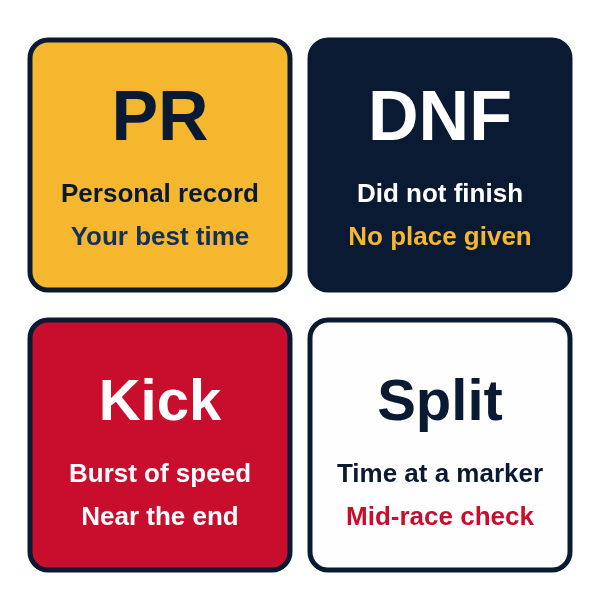
- A runner's time at a certain point in the race, such as a distance marker.
Scoring terms
- Place
- Where a runner finishes, such as first or twentieth. In team scoring, a place equals points.
- Team score
- The total of the points of a team's scoring runners. The lowest score wins.
- Scoring runner
- A runner whose place counts toward the team's total.
- Displacer
- A finisher beyond the scoring group who does not score for their team but can push opponents' scorers back a place.
- Pack
- A group of teammates running close together. Coaches often like a tight pack.
- DNF
- "Did not finish." Used when a runner does not complete the course.
- DQ
- "Disqualified." Used when a runner is removed from the results for breaking a rule, such as leaving the course.
Performance terms
- PR
- Personal record, a runner's best time. Also called a PB, for personal best. A PR is usually specific to a course or distance.
- Pace
- How fast a runner moves, often described as time per mile or kilometer.
- Negative split
- Running the second half of a race faster than the first half.
- Kick
- A burst of speed near the end of a race.
Training terms
- Warm-up
- Easy jogging and drills before a workout or race to get the body ready.
- Cool-down
- Easy jogging or walking after hard effort.
- Easy run
- A relaxed run at a comfortable pace, where talking is possible. Most beginner training is easy running.
- Long run
- The longest run of a runner's week, done at an easy pace.
- Tempo run
- A steady, comfortably hard run, faster than easy but still controlled.
- Intervals
- Repeated faster efforts with rest or easy running between them.
- Fartlek
- A Swedish word meaning "speed play." Running with unstructured changes of pace, often made into a game.
- Hill repeats
- Running up a hill several times, with easy jogging or walking back down to recover.
- Taper
- Lighter training in the days (or sometimes weeks) before an important race so the body feels fresh.
- Spikes
- Lightweight running shoes with points on the sole for traction, sometimes allowed in cross country. Ask your coach first.
Want the bigger picture? Start with cross country rules for beginners and scoring, courses and race roles. When your child is ready for the season, read how to prepare for cross country season. The cross country hub collects all of our guides.
Do not worry about memorizing every word. Coaches and teammates will explain terms as they come up, and asking questions is always welcome. Most of these words become second nature after a couple of meets, and kids often enjoy using the lingo before their parents do.
Terms in action
Here is how the words fit together on a typical day. A runner arrives at the team tent, pins on a bib, does a warm-up and a few strides, then lines up in the start box. During the race a coach may call out a split at the mile marker so the runner can check race pace. After the finish the runner walks through the chute, then does an easy cool-down. Later, the posted results show the runner's place and time, and the team score shows how the scoring runners combined. If the time is a PR on that course, that is worth celebrating whatever the place.
How to use this glossary
At your first meet, you will probably hear several of these words in one conversation. A coach might say that a runner went out too fast, hit a good split at the first marker and held pace through the hills. Listen for the clues: place and score tell you about the team result, PR tells you about personal progress, and terms like easy run, tempo run and intervals describe the different kinds of workouts the team does during the week. Ask your child to teach you one new term after each practice. Explaining it helps them learn, and it makes cheering from the side of the course more fun.
More meet and team terms
- Dual meet
- A meet between two teams, often at one team's home course.
- Championship meet
- A larger meet near the end of the season, set up by the league or governing body. Qualifying rules vary.
- Varsity and JV
- Common school team levels, with varsity usually the top group and junior varsity (JV) for developing runners. How levels are set varies by league.
- Course preview
- Walking or easy jogging the course before the race to learn the turns and hills, when the meet allows it.
- Team tent
- The shelter or gathering spot where a team keeps bags and meets between races.
More training terms
- Strides
- Short, relaxed accelerations, often done after an easy run or before a race to practice good form.
- Recovery run
- A very easy, short run done after a harder day.
- Race pace
- The speed a runner plans to hold in a race.
- Positive split
- Running the second half of a race slower than the first, which often happens when a runner starts too fast.
- Shakeout
- A light, easy run, often the day before a race, to loosen up.
For help turning these words into a plan, see how to pace a cross country race for beginners and how to read cross country meet results.
In BlackForge Sports: one app for every sport your family plays, with live scores, highlights that make themselves and parent-controlled profiles. Get early access and tell us you’re here for cross country. Get early access →
Sources and further reading
- Cross-country Encyclopaedia Britannica
- USA Track & Field: Cross Country USATF
- NFHS - Cross Country Rules NFHS
Links open in a new tab. Quotations are short excerpts, included with attribution for commentary. BlackForge Sports is not affiliated with or endorsed by the people or organizations named.
Frequently asked questions
What does PR mean in cross country?
PR means personal record, a runner's best time. It is often tied to a specific course or distance.
What is a split?
A split is a runner's time at a point partway through a race, such as at a distance marker.
What is a fartlek?
It is a Swedish word for speed play, a run with informal changes of pace.
What does DNF mean?
DNF means did not finish, used when a runner does not complete the course.
What is a taper?
A taper is lighter training in the days before an important race so a runner feels fresh. Ask your coach what the plan is for your team.