

Baseball guide
The baseball strike zone, explained
The strike zone decides whether a pitch is a ball or a strike. It sounds simple, but it surprises a lot of parents. Here is the official definition, how the count works and why youth games can feel inconsistent.
The official definition
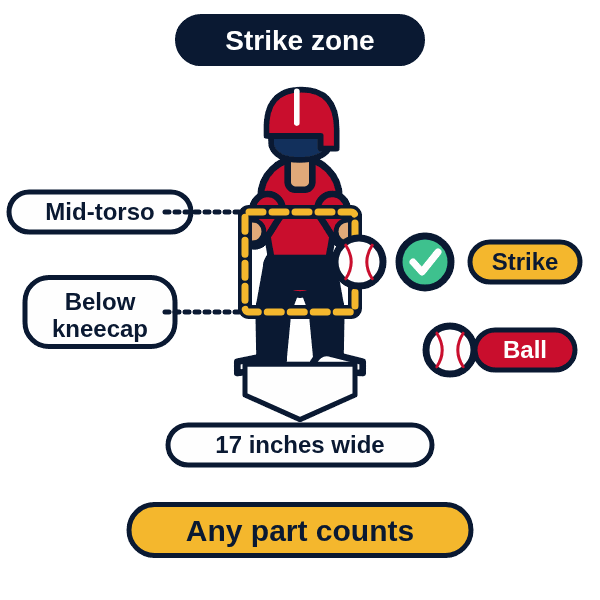
Under the official (professional) rules of baseball, the strike zone is the area over home plate from the midpoint between the top of the batter's shoulders and the top of the uniform pants (when the batter is in a natural batting stance) down to the hollow beneath the kneecap. A pitch is a strike if any part of the ball passes through that zone. Other levels word the zone a little differently (for example, some high school rules use the armpits to the knees), so your league's rulebook is the final word. Little League's rules, for example, define the zone as the space over home plate between the batter's armpits and the top of the knees in a natural stance, and the umpire sets it by the batter's usual stance when swinging at a pitch.
- Width: home plate is 17 inches wide, and the zone is as wide as the plate. Because any part of the ball counts, a pitch that just clips the edge is a strike.
- Height: the zone moves with the batter. A taller batter has a taller zone. It is not a fixed box.
What counts as a strike
- A pitch in the zone that the batter doesn't swing at (a called strike).
- A pitch the batter swings at and misses, anywhere.
- A foul ball, unless the batter already has two strikes (a foul bunt with two strikes is a strikeout).
The count
The count is balls first, then strikes. A 3-2 count (a full count) means three balls and two strikes. Four balls is a walk, three strikes is a strikeout. A count is part of the box score in many apps and in a scorebook, see how to keep score.
Picturing the zone
Imagine a box standing on top of home plate. The bottom edge is around the knees and the top edge is around the belt-to-chest area, depending on the rulebook. The ball does not have to be fully inside the box. If any part of it touches the zone as it crosses the plate, it is a strike. A pitch that bounces before it reaches the plate is generally a ball, even if it would have crossed the zone, and the batter may swing at it anyway.
Strike or ball? Examples
| Pitch | Call |
|---|---|
| Over the middle of the plate at the belt | Strike |
| Clips the outside edge of the plate | Strike, because any part of the ball counts |
| Well off the plate, batter takes it | Ball |
| Well off the plate, batter swings and misses | Strike |
| Bounces in the dirt, batter takes it | Ball |
| Above the shoulders, batter takes it | Ball |
How the batter's stance changes the zone
The zone is based on the batter's natural stance when the pitch arrives. A batter who crouches in an exaggerated way to shrink the zone is generally judged by the umpire as if standing in a normal stance. As kids grow quickly, a player's zone changes from season to season, so a batter may need to re-learn which pitches are strikes after a growth spurt.
Myths about the strike zone
- Myth: the zone is a fixed rectangle. It is set by the batter's stance and height, so it moves from batter to batter.
- Myth: the whole ball must cross the zone. Any part of the ball touching the zone is enough.
- Myth: a swing-and-miss only counts if the pitch is a strike. A swing and miss is a strike wherever the pitch is.
- Myth: umpires should call the same zone at every level. Rulebooks differ, and youth umpires are still learning.
Two-strike approach
With two strikes, a batter should shorten up, widen the zone in their mind to include borderline pitches and try to put the ball in play. With no strikes, a batter can be patient and wait for a good pitch. Teaching kids to adjust to the count is one of the most useful baseball habits, and it makes the count easier to understand as a spectator too. For a longer look at how a game flows, see baseball rules for beginners.
For pitchers
Pitchers who throw strikes get more outs on fewer pitches, which also helps with pitch limits. Aim for the middle of the zone at younger ages rather than trying to hit corners. Walks tend to come from trying to be too fine. See youth pitch count rules for why efficiency matters.
Talking about calls with kids
- Remind players that every umpire sees the zone a little differently and the call is the same for both teams.
- Teach batters with two strikes to protect the plate by swinging at anything close.
- Teach pitchers to move on to the next pitch. Dwelling on a call hurts the next pitch more than the call did.
- Parents should model the behavior they want. Applauding both teams' good plays sets the tone.
Learning the zone at home
A simple drill: have a parent or coach pitch soft toss or underhand to a child, and have the child call "ball" or "strike" before the pitch arrives. Kids who know the zone swing at better pitches, which means more contact and fewer strikeouts. For how strikes and balls end up in the scorebook, see how to keep score.
Why youth strike zones vary
- Umpires are often volunteers or teenagers doing their best, and zones differ from umpire to umpire.
- Younger divisions may have modified rules entirely. Little League's rules give one definition of the zone, and its umpire tips say borderline pitches should be called strikes to encourage batters to swing.
- Consistency matters more than precision. Teach kids to watch the umpire's zone for the first few pitches and adjust.
Tips for players and parents
- Encourage batters to swing at good pitches and take pitches clearly outside the zone. Chasing balls leads to strikeouts.
- Teach pitchers to throw strikes, but not to stress over every call.
- Never argue calls from the stands. Umpires' calls are final, and respect makes the game better for the kids.
Next: baseball rules for beginners.
Sources and further reading
- Strike Zone MLB Glossary
- Definition of the Little League® Strike Zone Little League
- Baseball - Rules, Strategy, Stats Encyclopaedia Britannica
Links open in a new tab. Quotations are short excerpts, included with attribution for commentary. BlackForge Sports is not affiliated with or endorsed by the people or organizations named.
Frequently asked questions
What is the baseball strike zone?
In official baseball rules, the area over home plate from the midpoint between the top of the batter's shoulders and the top of the pants down to the hollow beneath the kneecap. Any part of the ball in that area is a strike. Some levels define it slightly differently.
How wide is home plate?
Home plate is 17 inches wide, and the strike zone is as wide as the plate.
What is a full count?
Three balls and two strikes. The next pitch will either be a walk, a strikeout, or a ball put in play or fouled off.
Is the strike zone the same for every batter?
No. It depends on the batter's stance and height, so it is bigger for taller batters.
Is a pitch that bounces a strike?
Generally no. A pitch that hits the ground before reaching the plate is a ball unless the batter swings and misses, which is a strike.
Why do youth umpires call different zones?
Many are volunteers or teenagers, and zones vary from person to person. Little League's umpire tips also say borderline pitches should be called strikes, to encourage batters to swing. Your league's rules and the umpire's pregame talk are the final word.