

Soccer guide
Soccer offside explained
Offside is the rule that confuses almost every new soccer parent. This guide breaks it into a few simple ideas so you can understand the call, and explain it to your child.
Why offside exists
Offside is the rule that confuses nearly every new soccer parent, and it is easier than it looks. It exists so attackers cannot simply wait next to the goal for a long pass. It keeps the game spread out and rewards teamwork and timing.
One thing to know first: being in an offside position is not against the rules by itself. A player is only penalized if they are in that position and then get involved in the play.
The offside position
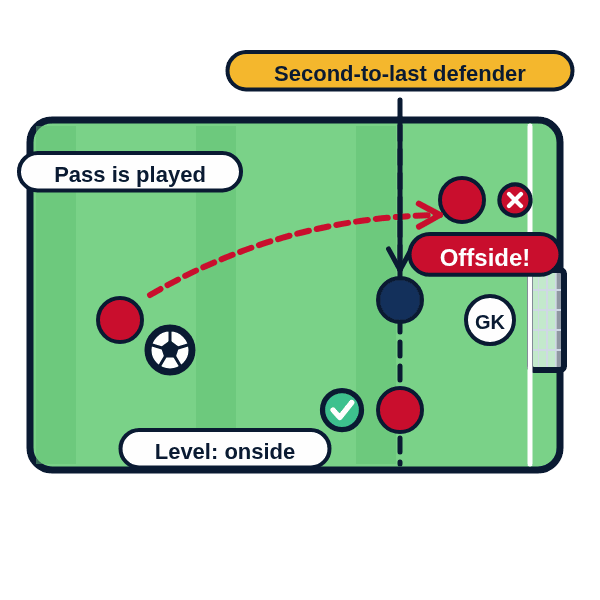
A player is in an offside position when, at the moment a teammate plays the ball to them, any part of their head, body or feet is closer to the opponents' goal line than both the ball and the second-to-last opponent. The goalkeeper usually counts as one of the opponents, so in practice the second-to-last opponent is often the last defender in front of the keeper.
Some details that clear up common confusion:
- Being level with the second-to-last defender is not offside.
- Hands and arms do not count for judging the position. Only parts of the body that can legally score count.
- A player in their own half of the field cannot be offside.
- The timing that matters is the moment the pass is played, not the moment the player receives it.
When offside is actually called
Being in an offside position leads to a call only if the player becomes involved in active play. In standard rules that generally means playing or touching the ball after a teammate passes it, interfering with an opponent, or gaining an advantage by being there. A player who stands in an offside position and does not affect the play is not penalized.
When offside is called, the other team gets an indirect free kick from the spot where the offside player became involved in the play, such as where they touched the ball, which can differ from where they stood when the pass was played.
- Pass played backward or sideways
- A player who is level with or behind the ball when it is played is never in an offside position. Position is judged at the moment the ball is played.
- Defender plays the ball on purpose
- Referees look at whether the defender had real control. A rushed, accidental touch is treated differently from a deliberate play.
When offside does not apply
There is no offside offense when a player receives the ball directly from a goal kick, a throw-in or a corner kick. That is why attackers can stand near the goal on a corner without being flagged. The rule applies in open play and some free kicks, once the ball is played to a teammate.
Offside in youth soccer
Whether offside is enforced varies by league and age group, so check with yours. Some leagues for the youngest players do not use it at all, while older age groups apply the standard rule. Even when it is used, the referee or an assistant may be a volunteer who is also learning, so expect some missed or debated calls.
If your child plays forward, a few simple habits help:
- Watch the last defender, and try to time runs so you start from level or behind.
- Keep your head up to see where the ball is as well as where the defenders are.
- Time your run so you start as the pass is played, not before.
A quick example: a midfielder passes forward while an attacker stands level with the last defender. The attacker is onside and can run onto the ball. If the attacker had been a step closer to the goal line than that defender when the pass was played, the assistant referee would raise a flag. The attacker's running speed after the pass does not matter, only the position at the moment of the pass.
Defenders can use the rule too. A line of defenders stepping forward together can leave an attacker offside. This takes practice and communication, so it is usually taught gradually.
For other rules, read soccer rules for beginners and fouls and cards explained. Roles on the field are covered in soccer positions explained, and every guide is listed on the soccer hub.
A step-by-step way to check offside
- Freeze the moment a teammate passes or touches the ball toward the attacker.
- Ask: was the attacker in the opponent's half?
- Ask: was the attacker closer to the opponent's goal line than the ball?
- Ask: was the attacker closer than the second-to-last opponent? (The goalkeeper usually counts as one of the opponents.)
- If yes to all three, the attacker is in an offside position. They are only penalized if they become involved in play, for example by receiving the pass.
Why offside is hard to judge
The decision depends on one moment, and players are moving fast. Assistant referees line up with the second-to-last defender to get the best view. At youth games with a single referee, calls can be missed or simplified. That is another reason to cheer for effort and let the referee do the job.
See soccer rules for beginners for the wider picture, and soccer positions explained to see which roles tend to stay near the offside line.
Offside myths
- "Standing in an offside position is a foul." It is not. The penalty comes only when the player becomes involved in play.
- "The ball must be level with the defender." Being level with the second-to-last opponent is not offside in standard rules.
- "Offside applies to every age." Many youth leagues relax or skip it, so ask yours before correcting anyone.
In BlackForge Sports: one app for every sport your family plays, with live scores, highlights that make themselves and parent-controlled profiles. Get early access and tell us you’re here for soccer. Get early access →
Sources and further reading
- Law 11 - Offside The IFAB
- Five Things to Know About U.S. Soccer Player Development Initiatives U.S. Soccer
Links open in a new tab. Quotations are short excerpts, included with attribution for commentary. BlackForge Sports is not affiliated with or endorsed by the people or organizations named.
Frequently asked questions
Is it a foul to be in an offside position?
No. A player is only penalized if they are in an offside position and then become involved in active play.
Can you be offside on a throw-in?
No. In standard rules, there is no offside offense directly from a throw-in, goal kick or corner kick.
Is being level with the last defender offside?
No. A player must be closer to the goal line than the second-to-last opponent to be in an offside position.
Do all youth leagues enforce offside?
No. It varies by league and age group, so check with yours.
Can you be offside from a throw-in?
No. In standard rules a player cannot be penalized for offside when receiving the ball directly from a throw-in, a goal kick or a corner kick.