

Rugby guide
Rugby terms for new parents
Rugby sounds like a foreign language to new parents. This glossary explains the words you will hear most, from tries to turnovers, grouped by where they come up in a game.
How to use this glossary
Rugby has its own vocabulary, and it can sound like a foreign language from the sideline. Here are the words you will hear most often, grouped by where you will hear them. Rules differ across youth leagues, so your coach is the final word.
Scoring and basics
- Try
- The main way to score. A player grounds the ball in the opponent's in-goal area. Worth five points in standard rules.
- Conversion
- A kick at goal taken after a try. Worth two points in standard rules.
- Penalty
- A kick awarded to one team after the other team breaks a rule. The team may kick at goal, kick to touch, or tap the ball and run. A free kick is similar for lesser offenses but cannot be kicked at goal for points directly.
- Drop goal
- A kick at goal during open play, made by dropping the ball and kicking it as it bounces. Worth three points in standard rules.
- In-goal
- The area behind the goal line where tries are scored.
- Touch
- The area outside the sidelines. When the ball goes into touch, play stops and restarts, usually with a lineout.
- Pitch
- The playing field.
Contact and the breakdown
- Tackle
- Bringing the ball carrier to the ground. The full international laws set the limit at the shoulders; in the US community game a tackle above the base of the sternum has been penalized since September 2024, and some youth programs set the limit lower still.
- Ruck
- Players from both teams bind over the ball on the ground after a tackle and compete for it on their feet.
- Maul
- A group moves together while the ball carrier is held up by opponents and supported by teammates.
- Breakdown
- A general term for the contest for the ball after a tackle, which includes rucks and mauls.
- Turnover
- When the team without the ball wins it, for example by stealing it at a ruck.
- Offside
- Being in a position where you are not allowed to take part in play. Referees award a penalty if it affects the game.
Set pieces and errors
- Scrum
- A restart where the forwards of both teams bind together and push for the ball fed in between them.
- Lineout
- A restart after the ball goes into touch. Players form two lines and jump to catch a throw-in.
- Knock-on
- Losing the ball forward, which usually gives the other team a scrum.
- Forward pass
- A pass thrown toward the opponent's goal line, which is not allowed.
- Advantage
- When the referee lets play continue after a rule break because the non-offending team is benefiting. You may hear the referee call it out.
- Sin bin
- A temporary suspension (shown with a yellow card) for a serious or repeated offense. In adult union it is usually ten minutes, but this varies by competition and youth league.
Roles and formats
- Forwards
- The players, numbered 1 to 8, who mostly contest the scrum, lineout and breakdown.
- Backs
- The players, numbered 9 to 15, who mostly move the ball and look for space.
- Sevens
- A faster version of rugby with seven players per side and much shorter matches.
- Tag rugby
- A non-contact version where players remove a tag or flag from the ball carrier instead of tackling.
Keep learning
Terms are easier to remember with context. Read rugby rules for beginners to see how these words fit together, then positions explained for who does what. All of our guides live on the rugby hub.
Phrases you will hear on the sideline
Beyond single words, coaches and referees use short phrases. "Support!" means get close to the ball carrier so the ball can be passed or protected. "Go forward" means keep pushing toward the opponent's goal line. "Release" is a referee's call for a tackled player to let go of the ball. "Hands away" tells players to take their hands off the ball at a ruck. You will also hear "advantage over" when a referee decides play has not benefited the team and goes back to the original rule break.
If you hear something that is not here, ask a coach or another parent. Everyone remembers being new, and rugby families are usually glad to help.
Terms by phase of play
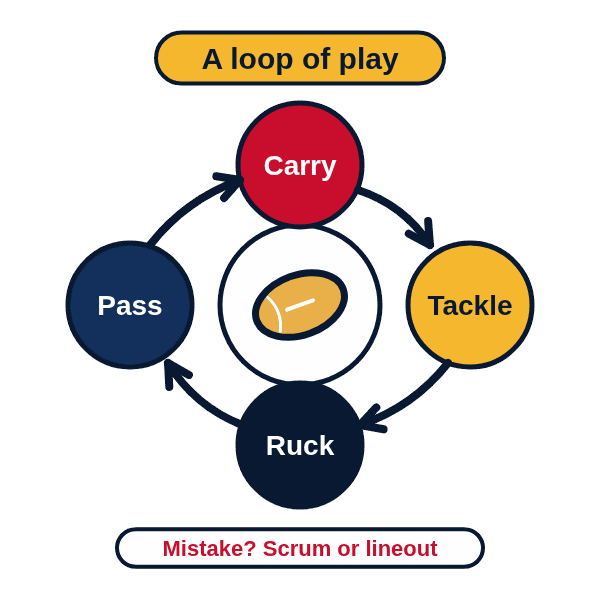
If the list feels long, remember that most of the action fits a simple loop: a player carries the ball, is tackled, and a ruck forms. Players then pass to keep the ball moving until someone scores, kicks or makes a mistake. A mistake brings a restart such as a scrum or lineout, and the loop begins again.
Listening for terms on the sideline
You will hear coaches and referees use short calls such as "support", "ball", "release" and "hands up". These are quick instructions to players, and nobody expects parents to know all of them at once. Pick up two or three new words each game, and ask another parent or the coach about anything that stays unclear. Most rugby families are glad to explain.
Terms that are easily confused
- Knock-on vs forward pass: a knock-on is a fumble that goes forward, while a forward pass is a throw that travels toward the opponent's goal line. Both usually lead to a scrum for the other team.
- Ruck vs maul: the ball is on the ground in a ruck and in a player's hands in a maul. Details are in the ruck and maul guide.
- Try vs touchdown: a try is scored by grounding the ball in the in-goal area, and it is worth the same whether it is near the posts or the sideline in standard rules.
- Union vs league vs sevens: see our comparison for how the games differ.
Whistle calls are covered in rugby referee calls explained, and set pieces in scrums and lineouts explained.
In BlackForge Sports: one app for every sport your family plays, with live scores, highlights that make themselves and parent-controlled profiles. Get early access and tell us you’re here for rugby. Get early access →
Sources and further reading
- Rugby's Laws: an evolution World Rugby
- Laws of the Game World Rugby
- rugby summary Encyclopaedia Britannica
Links open in a new tab. Quotations are short excerpts, included with attribution for commentary. BlackForge Sports is not affiliated with or endorsed by the people or organizations named.
Frequently asked questions
What is a try in rugby?
A try is scored when a player grounds the ball in the opponent's in-goal area, and it is worth five points in standard rules.
What is the difference between a ruck and a maul?
In a ruck the ball is on the ground and players compete for it on their feet. In a maul the ball carrier is still held up on their feet.
What is a knock-on?
A knock-on is when a player loses the ball forward. It usually results in a scrum for the other team.
What does offside mean in rugby?
It means a player is in a position where they are not allowed to take part in play, and the referee may award a penalty.
What is a turnover in rugby?
A turnover is when the team with the ball loses possession to the other team, for example after a mistake or a lost contest at a ruck.