


Baseball guide
How to set a youth baseball lineup and batting order
A good youth lineup balances development, fairness and winning. This guide explains the traditional batting order roles and how to adapt them for kids, plus how to rotate positions.
Start with your league's rules
Many youth leagues require playing time minimums, rotating positions or a continuous batting order where everyone bats. Learn the rules first. They may decide most of your lineup.
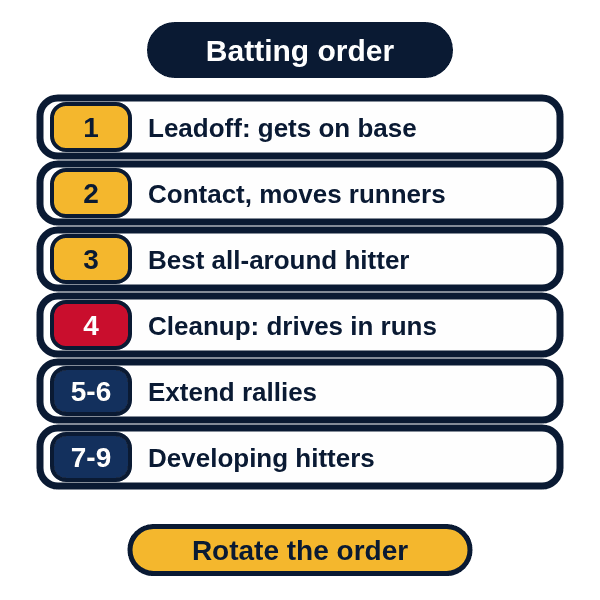
What each batting order spot traditionally does
| Spot | Typical role |
|---|---|
| 1: leadoff | Gets on base often and is a threat to run. |
| 2 | Makes contact and moves runners. |
| 3 | Usually the best all-around hitter. |
| 4: cleanup | Power hitter who drives in runners. |
| 5–6 | Solid hitters who extend rallies. |
| 7–9 | Developing hitters who also set the table for the top of the order. |
Use OBP and batting average to see who gets on base, and slugging percentage for power. See the stats glossary. Keep in mind that youth stats come from small samples and kids change quickly, so treat them as one input, not the whole answer.
Adapting this for kids
- Don't over-engineer it. Kids' skills change fast. A fixed lineup can lag behind their development.
- Rotate the order so everyone gets time at the top, where they get more at-bats.
- Explain roles positively. Every spot matters.
- Use a continuous batting order if your league allows, so no one sits out of the lineup.
Setting the defense
- Rotate positions through the season. Kids learn more, and you find hidden strengths. See baseball positions explained.
- Be thoughtful about pitching and catching. Follow pitch limits and rest rules. See pitch counts.
- Put your strongest arms where long throws happen, such as shortstop and third base, when it fits your rules.
- Pair strong and developing players so there is help at each position.
A sample lineup approach
Suppose you have twelve players and your league uses a continuous batting order. You might start the season by listing batters in the order you think works best, but then let players move up and down a spot or two each game. Kids who sit in the bottom of the order in one game bat near the top in the next. Over a season, everyone gets similar numbers of at-bats near the top, and kids are less likely to get the message that they are the weak link.
A step-by-step way to build a lineup
- Check your league's rules for playing time, batting order and positions.
- Write down who can play where. Include each child's strong spots and spots they want to learn.
- Pick your pitcher and catcher for the day based on rest and pitch limits. See pitch count rules.
- Fill in the infield and outfield, putting dependable fielders where most balls are hit at your level.
- Set the batting order, starting with who gets on base and who makes contact.
- Plan substitutions by inning so everyone gets a fair share.
- Write it on a card and share it with the dugout before the game.
Common lineup mistakes
- Always putting the same few kids in the outfield or on the bench. Rotate.
- Leaving weaker hitters at the bottom all season. They get fewer at-bats and development stalls.
- Making lineup decisions only on last game's result. Small samples mislead.
- Forgetting to tell the players their positions in advance. Kids play better when they know the plan.
Talking to players and parents
- Share your approach before the first game and keep to it.
- Tell each player what you want from them in their spot. "Your job is to see pitches" is more helpful than "bat ninth."
- Take questions privately, after the game, not in the dugout.
As players get older
Lineups usually get more competitive as kids move up. Even then, it helps to be transparent about how decisions are made, and to follow your league's playing time rules. For practices that build the skills behind a strong lineup, see how to run a practice.
A simple position rotation grid
A paper grid makes rotation easy. List players down the side and innings across the top, and write each child's position in each box. Aim for each child to play at least one infield spot and one outfield spot each game when your rules allow, and to sit out no more than the rules permit. A grid also protects you if a parent questions playing time, because you can show what each child played.
Substitutions and bench time
- Plan who sits each inning before the game, so you are not deciding on the spot.
- Rotate the bench so no child sits out the same inning repeatedly.
- Give bench players a job, like keeping score or helping with the equipment. They stay engaged and learn the game.
- Follow your league's rules about reentry and minimum innings.
Matching players to positions
- Quick reaction and a strong arm suit the left side of the infield.
- Good hands and footwork suit second base and first base.
- Speed and the ability to track fly balls suit the outfield, especially center field.
- Catching suits kids who are brave, focused and enjoy being in every play. Make sure a catcher has the gear and rest that the position needs.
Treat these as starting points. Young players are still developing, and you may be surprised who is good where.
Using stats without overdoing it
Stats can help, but keep them in proportion. A few weeks of at-bats is a small sample, and one bad week does not make a weak hitter. Use stats to spot trends, then confirm with what you see in practice. Share good news with players, and avoid posting stats in a way that embarrasses anyone.
Sharing playing time fairly
- Track innings played at each position. A simple scorebook or app does it.
- Tell parents your approach at the start of the season.
- Be consistent, and explain decisions to players.
In BlackForge Sports: scoring games builds each player's batting and fielding record, so you can see who is getting on base and where players have played. Get early access →
Sources and further reading
- Mandatory Play: What Parents Need to Know Little League International
- Regular Season to Tournament: Rule Differences Little League International
- Little League Baseball - Understanding The Basic Rules Little League International
Links open in a new tab. Quotations are short excerpts, included with attribution for commentary. BlackForge Sports is not affiliated with or endorsed by the people or organizations named.
Frequently asked questions
Who should bat leadoff in youth baseball?
A player who gets on base often and runs well. At younger ages, rotating the top of the order gives more kids more at-bats.
What is a continuous batting order?
Everyone on the roster bats in order, and players who sub in take the same spot. Many youth leagues use it.
Should kids play one position?
Younger players generally benefit from rotating positions. It builds skills and shows where they fit.
How do I use stats to set a lineup?
On-base percentage and batting average show who gets on base, and slugging percentage shows power.
How do I set a batting order for kids?
Check your league's rules, put players who get on base near the top, rotate spots over the season and explain each role positively.
How do I make sure everyone gets fair playing time?
Track innings played and positions for each child, plan substitutions in advance and tell parents how you will do it.