

Hockey guide
Hockey terms for new parents
Hockey comes with a lot of lingo. This glossary explains the words new parents hear most at the rink, in plain English and in alphabetical order.
How to use this glossary
Hockey has its own vocabulary, and at your child's first game it can sound like a foreign language. Skim the list below, then come back to it when you hear a word you do not know. Terms are in alphabetical order. Some details, such as which hits or shots are allowed, vary by league and age group, so ask your coach if something does not match what you see.
Hockey terms for new parents
- Assist
- Credit given to as many as two players who passed the puck to the goal scorer. Scoring rules for assists can vary by league.
- Blue line
- One of two blue lines that divide the rink into zones and decide whether a play is offside.
- Body check
- Using the body to separate an opponent from the puck. Many youth levels do not allow it.
- Breakaway
- When a player with the puck has no defender between them and the goalie.
- Crease
- The painted area around the goal where the goalie has special protection.
- Defenseman
- A player whose main job is protecting their own net and moving the puck up the ice.
- Deke
- A fake move that fools a defender or goalie.
- Empty net
- A net with no goalie, often because the goalie was replaced by an extra attacker when a team is trailing.
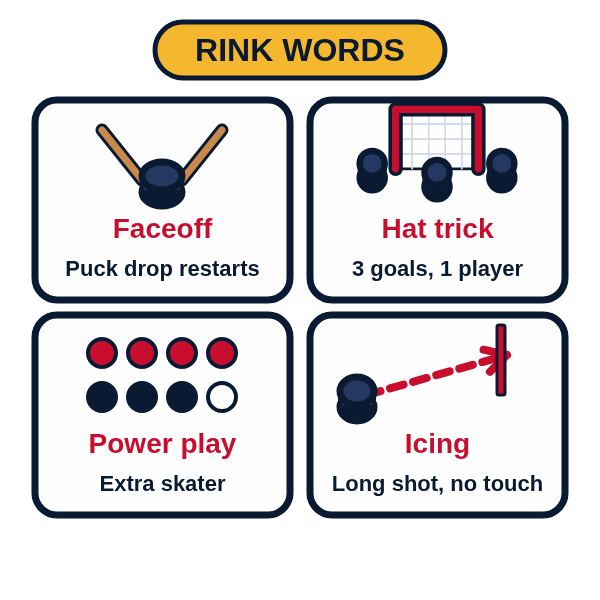
- Faceoff
- The way play starts or restarts, when an official drops the puck between two opposing players.
- Forecheck
- Pressuring the other team in its own end to win the puck back.
- Hat trick
- Three goals by one player in a game.
- Hooking
- A penalty for using the stick to hold or impede an opponent.
- Icing
- Shooting the puck from your own half past the opposing goal line without anyone touching it. Play stops, and the faceoff comes back to the end of the team that iced the puck. Rules vary by level.
- Line change
- Swapping a group of players on the ice for fresh ones, often during play.
- Neutral zone
- The middle area of the ice between the two blue lines.
- Offside
- When an attacking player crosses the blue line into the offensive zone ahead of the puck. Exact rules vary by level.
- Penalty box
- The bench area where penalized players serve their time.
- Power play
- When one team has more skaters on the ice because the other team has a player in the penalty box.
- Rebound
- A puck that bounces off the goalie or post after a shot, often creating a second chance.
- Shift
- The short time a player spends on the ice before a change.
- Slap shot
- A hard shot with a big wind-up, with the stick swung back and down.
- Slashing
- A penalty for swinging the stick at an opponent.
- Wrist shot
- A common shot where the puck is swept off the stick using the wrists, often more accurate than a slap shot.
- Zamboni
- The machine that resurfaces the ice between periods or sessions. Zamboni is a brand name, but many people use it for any ice resurfacer.
Words that confuse new parents
A few terms sound alike but mean different things. Icing and offside both stop play, yet icing is about a long shot from your own half while offside is about entering the attacking zone too early. A penalty sends a player to the box, while a faceoff is simply a restart. A line is a group of forwards and a shift is one turn on the ice. If you remember those pairs, most of the game will make sense.
Listening at the rink
You will also hear coaches shout short cues such as "back" or "man on." These are team signals and change from coach to coach, so ask your coach what the team uses.
Where to go next
Terms stick best when you see them in action. Read hockey rules for beginners for how the game flows, and hockey positions explained to match the words to the players on the ice. If you are new to the rink, you will also find useful tips in how to prepare for hockey season. When you are unsure, nobody minds a question. Parents and coaches would rather answer than watch you guess.
Terms you may hear only in youth hockey
Programs often have their own words, such as cross-ice for games played across the rink, station for a small group drill at practice, or half-ice for using one end. League names for age divisions also differ by region. When your club's welcome email uses a term you do not know, ask the coordinator rather than guessing.
Words for places on the ice
Several terms describe where things happen. The defensive zone is the area around the net a team is defending, the neutral zone is the middle and the offensive zone is the area around the opponent's net. The boards are the walls, the slot is the area in front of the net between the faceoff circles, and the point is the area near the blue line where defensemen often position themselves on offense. Learn these and a commentator's call becomes much easier to follow.
Words for stoppages
A whistle means play has stopped. After that, the game restarts with a faceoff. A delayed penalty means the official has seen a foul but is letting play continue for a moment. If you want to see how these calls work, read hockey penalties explained.
A simple way to learn the language
- Pick five terms from the glossary before each game.
- Listen for them at the rink and match each one to what you see.
- Ask your child to explain one afterward. Kids often love being the expert.
Many terms have local or regional variations, so if a word does not match this list, ask a coach.
In BlackForge Sports: one app for every sport your family plays, with live scores, highlights that make themselves and parent-controlled profiles. Get early access and tell us you’re here for hockey. Get early access →
Sources and further reading
- Information for New Hockey Parents USA Hockey
- What is ice hockey? Encyclopaedia Britannica
- Rule Book & Resources USA Hockey
Links open in a new tab. Quotations are short excerpts, included with attribution for commentary. BlackForge Sports is not affiliated with or endorsed by the people or organizations named.
Frequently asked questions
What does icing mean in hockey?
Icing is shooting the puck from your own half past the opposing goal line without anyone touching it. Play stops and the faceoff is in the end of the team that iced the puck. Rules vary by level.
What is a power play?
A power play is when one team has extra players on the ice because the other team has a player in the penalty box.
What is a hat trick?
A hat trick is three goals scored by one player in a single game.
What is a line change?
A line change is when a group of players leaves the ice and another group comes on, often during play.
What does offside mean in hockey?
In general, a team is offside when an attacking player crosses the blue line into the offensive zone before the puck. Exact rules vary by level.