

Basketball guide
Basketball terms for new parents
Basketball has plenty of lingo. This glossary explains the terms new parents hear most, in plain English, so you can follow along from the stands.
How to use this glossary
Basketball has its own vocabulary, and hearing it from the stands can feel like a foreign language. Here are the terms you will hear most, in alphabetical order, in plain English. League rules vary, so if a coach or referee explains something differently, go with them.
The glossary
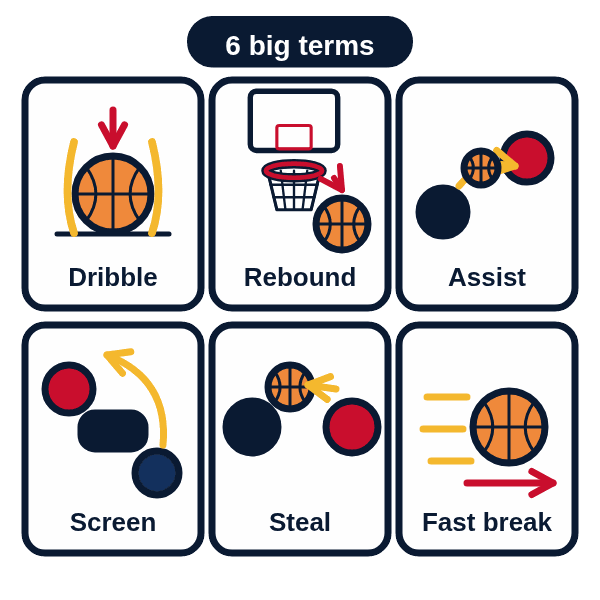
- Assist
- A pass that leads directly to a teammate's made basket.
- Backcourt
- The half of the court that contains the basket a team is defending. In standard rules, a team that has moved the ball into the frontcourt generally cannot take it back into the backcourt (a backcourt or over-and-back violation).
- Block
- A defender legally deflecting a shot in the air.
- Boxing out
- Using your body to keep an opponent away from the basket so a teammate can grab the rebound.
- Charge
- An offensive foul when a player with the ball runs into a defender who has established a legal guarding position. Exact charge and block rules vary by rule set.
- Dribble
- Bouncing the ball while moving.
- Double dribble
- A violation: dribbling after you have stopped, or dribbling with two hands at the same time.
- Fast break
- A quick attack up the court after gaining possession, before the defense is set.
- Field goal
- Any made shot that is not a free throw.
- Foul
- Illegal contact. Too many fouls can send a player to the bench.
- Free throw
- An unguarded shot from the free-throw line, worth one point.
- Jump ball
- A method of starting play in which an official tosses the ball up between two players. Some leagues use alternating possession instead.
- Layup
- A shot taken close to the basket, usually while moving, often off the backboard.
- Man-to-man
- A defense in which each player guards a specific opponent.
- The paint
- The painted area near the basket, also called the key or lane.
- Pivot
- Turning on one foot while the other foot stays in place.
- Rebound
- Gaining control of the ball after a missed shot.
- Screen
- A legal block set by a player to free a teammate from a defender. Also called a pick.
- Steal
- Taking the ball away from an opponent.
- Three-point line
- The arc on the court. Shots made from behind it are worth three points in standard rules.
- Timeout
- A stoppage requested by a coach or player to rest or talk strategy.
- Travel
- Taking too many steps without dribbling. Also called traveling.
- Turnover
- Losing the ball to the other team without taking a shot, such as by a steal, a bad pass or a violation.
- Zone defense
- A defense in which players guard areas of the court instead of specific opponents. Some youth leagues limit it.
More terms you may hear
- Baseline
- The boundary line behind each basket, also called the end line.
- Bounce pass
- A pass that bounces once on the floor before reaching the receiver.
- Chest pass
- A two-handed pass thrown from the chest straight to a teammate.
- Dead ball
- A moment when play is stopped, such as after a whistle. Substitutions often happen then.
- Inbound
- Putting the ball back into play from out of bounds, usually with a pass.
- Jump shot
- A shot taken while jumping, away from the basket.
- Offense and defense
- The team with the ball is on offense. The other team is on defense.
- Overtime
- An extra period some leagues use to break a tie. Youth leagues vary.
- Personal foul
- A foul involving illegal contact. Players leave a game after a set number, which varies.
- Possession
- Having control of the ball, and the right to try to score with it.
- Technical foul
- A foul for unsporting behavior rather than contact. It can be called on players, coaches or the bench.
Terms that are easy to mix up
- Block versus steal: a block deflects a shot, while a steal takes the ball from a player who is dribbling or passing.
- Foul versus violation: a foul involves illegal contact, and a violation, such as traveling, does not. See basketball fouls and violations explained.
- Guard versus guarding: a guard is a position, but any player can guard an opponent on defense.
Listening for terms in a real game
Here is a simple way to put the glossary to use. At your child's next game, pick three terms and listen for them. You might hear the referee call a foul or a travel, hear a coach shout for a rebound or a screen, and see a turnover turn into a fast break. Connecting a word to something you saw is the quickest way to make it stick.
Some words also differ slightly between leagues, and families from other places may use different names for the same thing. When in doubt, a quick question to the coach clears it up.
Tips for learning the language
You do not need to memorize every term before the first game. Start with the ones you will hear most: dribble, foul, rebound, travel and free throw. The rest will make sense quickly as you watch.
If you are curious how these terms fit together in a game, read basketball rules for beginners. To learn who plays where, see basketball positions explained. All of our guides are on the basketball hub.
When you hear a term you do not know, ask. Coaches and other parents are usually happy to explain, and many remember being new themselves.
Tips for learning the language quickly
You do not need to memorize every term before the first game. Pick up a few at a time by listening to the coach and watching what happens right after a word is used. When you hear "transition," for example, notice that the teams are racing from one end of the court to the other. When you hear "screen," look for a player standing still so a teammate can run past.
- Keep a short list on your phone of words you hear and want to look up later.
- Ask your child to teach you one term after practice. Explaining it helps them learn it too.
- Read about whistles and calls in fouls and violations explained and about the numbers on the scoreboard in basketball scoring explained.
In BlackForge Sports: one app for every sport your family plays, with live scores, highlights that make themselves and parent-controlled profiles. Get early access and tell us you’re here for basketball. Get early access →
Sources and further reading
- Basketball (Kids) Encyclopaedia Britannica
- NFHS - Basketball Rules National Federation of State High School Associations
- FIBA Official Basketball Rules 2024 come into force on October 1 FIBA
Links open in a new tab. Quotations are short excerpts, included with attribution for commentary. BlackForge Sports is not affiliated with or endorsed by the people or organizations named.
Frequently asked questions
What does boxing out mean?
Boxing out means using your body to keep an opponent away from the basket so a teammate can get the rebound.
What is the difference between a turnover and a steal?
A steal is when a defender takes the ball away. A turnover is any loss of the ball to the other team without a shot, including steals.
What is the paint?
The painted area near the basket, also called the key or lane.
What is zone defense?
A defense where players guard areas of the court rather than specific opponents. Some youth leagues limit it.
What does inbound mean?
To inbound is to put the ball back in play from out of bounds, usually with a pass from the sideline or baseline.